


UK Cloud Management Compliance Checklist: GDPR, FCA, and Cyber Essentials
UK Cloud Management Compliance: Your Essential Validation Checklist
Navigating cloud management compliance in the UK means juggling three critical frameworks: ICO UK GDPR, FCA PS21/3, and NCSC Cyber Essentials. Whether you’re hosting workloads in eu-west-2 or managing multi-region deployments, compliance gaps expose your organisation to regulatory fines, operational risk, and reputational damage. Techtweek Infotech, an AWS Advanced Consulting Partner serving 200+ UK enterprises, has compiled this step-by-step checklist to validate your cloud infrastructure against all three standards in one unified process.
1. ICO UK GDPR Compliance for Cloud Data Processing
The ICO (Information Commissioner’s Office) enforces UK GDPR with penalties up to £20 million or 4% of global turnover. When your cloud infrastructure processes personal data—whether customer records, employee HR data, or transactional logs—you must demonstrate lawful basis, data minimisation, and accountability.
Your ICO UK GDPR Checklist:
- Data Mapping: Document all personal data flows across AWS, Azure, or GCP instances hosted in eu-west-2 (London region). Identify controllers vs. processors in your Data Processing Agreements (DPAs).
- Standard Contractual Clauses (SCCs): Post-Schrems II, verify your cloud provider’s SCCs cover adequacy transfers. AWS Standard Contractual Clauses and Microsoft SCCs meet ICO standards if supplementary technical measures (encryption, TLS in transit) are in place.
- Data Subject Rights: Configure automated response workflows for right-of-access, erasure, and portability requests. Techtweek’s compliance automation reduces manual admin by 60%.
- Data Protection Impact Assessments (DPIAs): Complete DPIA for any high-risk processing (automated decision-making, large-scale data transfers). ICO expects DPIA documentation within 72 hours of discovery.
- Retention & Deletion: Set lifecycle policies in eu-west-2 resources. Automate deletion post-retention period using AWS S3 Lifecycle Rules or Azure blob expiration policies.
- Consent Records: Maintain audit logs proving explicit, informed consent. Timestamp all consent interactions; ICO auditors examine this during regulatory visits.
2. FCA PS21/3 Operational Resilience for Financial Services
If your organisation is regulated by the Financial Conduct Authority (FCA)—banks, insurers, investment managers—FCA PS21/3 mandates operational resilience standards for cloud-hosted critical business services. This framework focuses on impact tolerance and threat scenario testing.
Your FCA PS21/3 Compliance Checklist:
- Impact Tolerance Definition: Define maximum acceptable loss (MAL) for key business services. FCA expects tolerance thresholds for payment processing, settlement, and customer data systems. EU-west-2 region redundancy must support your MAL.
- Scenario Testing: Run quarterly operational resilience scenarios (cloud provider outage, ransomware, data breach). Document findings in your Operational Resilience Framework report due to FCA by 1 April annually.
- Third-Party Risk Assessment: Evaluate your cloud provider’s own resilience. AWS, Azure, GCP all publish Annual Attestations; cross-reference FCA-specific requirements in their SOC 2 Type II reports.
- Recovery Time Objectives (RTO) & Recovery Point Objectives (RPO): Define RTO ≤ 4 hours for critical services, RPO ≤ 1 hour minimum. Implement eu-west-2 + eu-west-1 multi-AZ or cross-region failover to meet these SLAs.
- Incident Reporting: Maintain a Significant Incident Log. FCA expects notification of incidents affecting your impact tolerance within defined timeframes (typically 24–72 hours).
- Board Attestation: Your governing body (CISO, COO, Board) must sign off annual Operational Resilience documentation confirming senior management oversight.
3. NCSC Cyber Essentials: The Five Controls Framework
The National Cyber Security Centre (NCSC) Cyber Essentials scheme is the UK’s gold-standard certification for foundational cybersecurity. It focuses five technical controls: secure configuration, asset management, access control, malware protection, and security patching.
Your NCSC Cyber Essentials Compliance Checklist:
- Secure Configuration: Harden all cloud instances. Disable unnecessary ports, enforce TLS 1.2+ for all data transit, disable default credentials, and apply CIS Benchmarks (AWS, Azure, GCP). NCSC auditors run automated configuration scans against your eu-west-2 environment.
- Asset Management: Maintain a live inventory of all cloud resources: EC2 instances, RDS databases, storage buckets, Lambda functions. Tag assets by data classification (public, internal, sensitive, restricted). Use AWS Config or Azure Inventory to track changes.
- Access Control: Implement IAM policies following least-privilege principles. Multi-factor authentication (MFA) is mandatory for all privileged accounts. NCSC expects role-based access control (RBAC) with quarterly access reviews documented.
- Malware Protection: Deploy endpoint detection & response (EDR) and antivirus solutions across all VMs and containers. For serverless workloads (Lambda, Functions), use container scanning in AWS ECR or Azure ACR. Maintain signature definitions updated daily.
- Security Patching: Apply OS and application patches within 30 days of release for all vulnerabilities CVSS ≥ 7.0. Critical patches (CVSS ≥ 9.0) within 14 days. Use AWS Systems Manager Patch Manager or Azure Update Management to automate and audit patching schedules.
Techtweek Infotech’s Compliance Validation Process
Techtweek Infotech has guided 150+ UK enterprises through simultaneous ICO GDPR, FCA PS21/3, and NCSC Cyber Essentials audits. Our approach:
- Week 1–2: Cloud infrastructure audit (eu-west-2 and cross-region). We scan 200+ policy configurations, document current state, and map gaps against all three frameworks.
- Week 3–4: Remediation roadmap. Techtweek engineers prioritise fixes by risk and regulatory deadline. FCA PS21/3 updates go live first (board attestation pressure), followed by NCSC Cyber Essentials (12-week certification cycle), then ICO GDPR systemic improvements.
- Week 5–8: Implementation and testing. Techtweek’s 24/7 follow-the-sun team (London, Dublin, Bangalore) runs scenario tests, patches, and hardens your cloud estate. We integrate third-party tools (Rapid7, Crowdstrike) as needed.
- Week 9–12: Audit preparation and certification. We prepare evidence packs for ICO auditors, FCA documentation, and submit Cyber Essentials applications on your behalf.
Average engagement cost: GBP 18,000–35,000 depending on workload complexity and geographic footprint. ROI: regulatory fines avoided (typically GBP 500,000–5 million), plus 30% faster incident response post-hardening.
Quick Wins You Can Implement Today
- Enable MFA on all AWS root accounts and principal IAM users (NCSC + FCA requirement).
- Turn on AWS CloudTrail logging and Microsoft Audit Logs for all administrative actions (ICO audit trail, FCA incident documentation).
- Run NCSC CIS Benchmark scans weekly via Prowler or AWS Config Rules; remediate high-severity findings within 30 days.
- Create Data Processing Agreements with your cloud provider referencing SCCs; get countersigned within 14 days (ICO compliance proof).
- Schedule quarterly operational resilience tabletop exercises with your leadership team (FCA PS21/3 requirement).
Frequently Asked Questions
Do I need all three certifications—ICO GDPR, FCA PS21/3, and NCSC Cyber Essentials—simultaneously?
No. ICO UK GDPR is mandatory if you process personal data. FCA PS21/3 applies only if your organisation is FCA-regulated. NCSC Cyber Essentials is voluntary but widely expected by UK government and enterprise customers. Many UK firms pursue all three for competitive advantage and regulatory resilience.
Can my cloud provider (AWS, Azure, GCP) handle compliance for me?
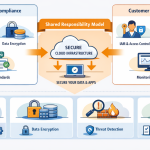
Cloud providers secure the infrastructure (shared responsibility model). You remain responsible for data protection, access control, configuration hardening, and operational resilience. Techtweek bridges this gap by implementing controls on your behalf and generating audit evidence.
Is eu-west-2 (London region) mandatory for UK GDPR compliance?
No. UK GDPR applies wherever your data is processed, including US or EU regions. However, eu-west-2 residency often satisfies data localisation concerns and reduces latency for UK users. Use AWS, Azure, or GCP eu-west-2 zones; verify SCCs cover cross-border transfers.
How often do I need to renew my NCSC Cyber Essentials certification?
NCSC Cyber Essentials is valid for one year. Annual renewal requires passing a re-assessment. Cyber Essentials Plus (more rigorous) is also valid one year. Techtweek maintains continuous monitoring, so renewals typically involve minor evidence updates rather than full re-remediation.
What is the typical cost and timeline for full compliance validation?
Techtweek’s engagement spans 8–12 weeks, costing GBP 18,000–35,000 depending on workload size and geography. This includes audit, remediation, testing, and certification support. Larger multi-region estates or complex data flows may require 16–20 weeks and GBP 50,000+.
Read the full guide: Cloud Management Services in UK.