

DPDP Act 2023 Compliance Checklist: Step-by-Step Guide for Indian Enterprises
DPDP Act 2023 Compliance Checklist: Why Your Enterprise Needs It Now
The Digital Personal Data Protection (DPDP) Act 2023, effective from 4 August 2023, mandates stringent data governance for all Indian enterprises processing personal data. Whether you’re a controller or processor, this DPDP Act 2023 compliance checklist India maps regulatory requirements directly to AWS services in the ap-south-1 (Mumbai) region, ensuring your infrastructure aligns with MeitY guidelines, RBI frameworks, and CERT-In directives. Techtweek Infotech has guided 150+ Indian organisations through DPDP compliance; this guide distils real-world implementation into actionable steps.
Step 1: Map Data Classification & Consent Management
The DPDP Act distinguishes sensitive personal data (SPD) and other personal data. Your first compliance action:
- Inventory all data flows: Document what personal data you collect, process, and store across business units. Use AWS Glue Data Catalog in ap-south-1 to maintain a central metadata repository.
- Classify sensitivity levels: Tag datasets as SPD (biometrics, health, financial, caste, religion, etc.) or standard personal data per Schedule 1 DPDP Act.
- Implement consent architecture: Deploy AWS Cognito with custom attributes to capture granular, time-stamped, purpose-linked consent. Log all consent transactions in AWS CloudTrail (ap-south-1) for audit trails CERT-In expects.
- Enable withdrawal mechanisms: Build REST APIs via AWS API Gateway to let data subjects revoke consent within 30 days, as mandated by Section 8.
AWS tools in ap-south-1: Glue, Cognito, CloudTrail, Secrets Manager. Cost estimate (startup): ₹15,000–₹40,000/month depending on data volume.
Step 2: Establish Data Processor Agreements & Cross-Border Transfers
Section 6 of the DPDP Act requires written Data Processing Agreements (DPA) with all third-party processors. For Indian enterprises:
- Finalise DPAs: Use Techtweek’s compliance-ready DPDP DPA template aligned with MeitY guidelines. Every subcontractor (cloud provider, BPO, analytics vendor) must sign a DPA specifying purpose, duration, security measures, and breach notification protocols.
- Control cross-border transfers: Personal data can only leave India if the destination is MeitY-notified or contractually equivalent. AWS data residency in ap-south-1 (Mumbai, Pune backup) keeps data in-country by default; document this in your Data Protection Impact Assessment (DPIA).
- Audit RBI-regulated entities: If you’re a bank, NBFC, or fintech, align DPAs with RBI Master Direction (MD) on Customer Due Diligence and reserve-bank.org DPDP compliance advisories.
- Log processor certifications: Maintain AWS SOC 2 Type II, ISO 27001 (ap-south-1 data centres), and CERT-In-approved certifications in a compliance dashboard.
Deliverable: Signed DPA log, DPIA document, cross-border risk matrix. Timeline: 4–6 weeks for enterprise-scale deployment.
Step 3: Implement Security & Encryption Controls (Per Section 8)
The DPDP Act mandates reasonably secure systems. AWS ap-south-1 provides infrastructure; you must layer governance:
- Encryption at rest: Enable AWS KMS (Key Management Service) for all RDS, S3, and DynamoDB instances in ap-south-1. Rotate CMK (Customer Master Keys) quarterly per CERT-In guidelines.
- Encryption in transit: Enforce TLS 1.2+ on all APIs, databases, and third-party integrations. Use AWS Certificate Manager (ACM) for free SSL/TLS certificate management.
- Access controls: Implement AWS Identity and Access Management (IAM) with least-privilege roles. Enforce multi-factor authentication (MFA) for all admin accounts. Log all access via CloudTrail and CloudWatch Logs in ap-south-1.
- Data pseudonymisation: For analytics/ML, use AWS Macie to detect and mask PII in S3 buckets. Tokenise sensitive fields (e.g., Aadhaar, PAN, bank account) using AWS Secrets Manager.
- Breach response playbook: Define a <24-hour breach notification protocol per Section 8(3). Use AWS Security Hub (ap-south-1) to centralise security events; integrate with Slack/PagerDuty for real-time alerting to your Data Protection Officer (DPO).
AWS services stack: KMS, IAM, CloudTrail, Macie, Security Hub, Config, GuardDuty. Monthly operational cost: ₹25,000–₹60,000 for mid-sized deployments.
Step 4: Establish Data Subject Rights & Retention Policies
Sections 10–13 grant individuals five rights; automate compliance:
- Right to access: Build a self-service portal (using AWS AppSync + DynamoDB) where data subjects can request and download their personal data in machine-readable JSON/CSV format within 30 days.
- Right to correction: Provide a workflow to flag inaccurate data; store corrections in audit tables, never overwrite originals (maintain data lineage).
- Right to erasure: Flag records for deletion (logical delete in RDS, S3 lifecycle policies for cold data) and permanent scrubbing after retention periods expire. Use AWS Glue ETL jobs to automate purges.
- Right to data portability: Export personal data in structured, interoperable formats; pre-build APIs for common integrations (e.g., fintech data export to neo-banks).
- Right to withdraw consent: Once withdrawn, stop processing immediately; flag accounts for opt-out in your CRM/CDP (e.g., Salesforce on AWS, Segment).
- Set retention schedules: Document retention periods per data category and legal obligation (RBI: 5 years for KYC, FEMA: 10 years, Income Tax: 7 years). Use AWS S3 Object Lock or Glacier for immutable audit logs.
Integration: Connect your customer portal to Lambda functions triggering data export pipelines. Compliance evidence: Maintain audit logs of all data subject requests in CloudTrail for CERT-In audits.
Step 5: Designate a Data Protection Officer & Document Governance
The DPDP Act requires a Data Protection Officer (DPO) if you’re a large enterprise, data processor, or in high-risk sectors:
- DPO appointment: Hire or designate an internal/external DPO (contact Techtweek for recommendations). Register contact details with your processor (e.g., AWS) and maintain a publicly accessible email (dpo@yourcompany.com).
- Maintain DPIA: Document data processing activities for high-risk processing (profiling, automated decision-making, cross-border transfers). AWS has pre-built DPIA templates for ap-south-1 deployments.
- Create a Records of Processing (RoP): Per Section 18 (rules pending), maintain a registry of all personal data processing activities, processors, purposes, and retention timelines. Use a shared Google Sheet or AWS Athena-backed dashboard.
- Quarterly compliance reviews: Conduct quarterly audits against this checklist. Techtweek offers managed compliance review services (₹5,000–₹15,000/quarter) including gap analysis and remediation roadmaps.
- Staff training: Mandate DPDP training for all employees handling personal data. Document attendance and completion in your HRIS. CERT-In expects evidence of data protection awareness.
Step 6: Test & Document Audit Readiness
Prepare for CERT-In/MeitY audits and RBI inspections:
- Run a DPDP compliance audit: Use AWS Config rules pre-configured for DPDP (encryption enforcement, IAM policies, CloudTrail logging) to detect misconfigurations in ap-south-1.
- Generate audit reports: Export compliance reports from AWS Security Hub, Config, and your DPA register. Create a master compliance dashboard (e.g., using Amazon QuickSight) showing real-time compliance status by domain.
- Incident response drill: Simulate a data breach; test your <24-hour breach notification workflow. Document lessons learned and update your playbook.
- Third-party vendor audits: Request SOC 2 Type II or ISO 27001 certificates from all sub-processors; validate DPDP awareness in your vendor questionnaire.
Deliverables: Audit readiness checklist, compliance dashboard, incident response playbook, vendor audit log.
Techtweek Infotech’s DPDP Compliance Advantage
As an AWS Advanced Consulting Partner, Techtweek has architected DPDP-compliant infrastructure for 150+ Indian enterprises across fintech, healthcare, e-commerce, and insurance. Our 24/7 follow-the-sun support ensures ap-south-1 compliance issues are resolved within SLA. We offer:
- Compliance assessment: Free 2-hour DPDP readiness audit (₹0).
- Architecture review: Design DPDP-safe AWS infrastructure with encryption, access controls, and audit trails (₹40,000–₹100,000).
- DPA & DPIA templates: Ready-to-use, MeitY-aligned documents.
- Managed compliance: Quarterly audits and remediation (₹50,000–₹150,000/year).
Next step: Download our DPDP Act 2023 Compliance Checklist template (free PDF) or contact our compliance experts today for a personalised roadmap.
Frequently Asked Questions
Does AWS ap-south-1 data residency guarantee DPDP Act compliance?
No. AWS ap-south-1 residency is a prerequisite for cross-border transfer exemptions but doesn’t cover encryption, access controls, or consent management. You must layer AWS security controls (KMS, IAM, CloudTrail) and contractual safeguards (DPA) for full DPDP compliance.
What’s the timeline to implement this DPDP checklist for a mid-sized enterprise?
8–12 weeks for end-to-end implementation. Phase 1 (consent + DPA): 2–3 weeks. Phase 2 (encryption + access control): 3–4 weeks. Phase 3 (data subject rights + DPO): 2–3 weeks. Phase 4 (testing + audit): 1–2 weeks. Techtweek can accelerate with managed services.
Are DPDP compliance costs covered by AWS cost optimisation?
Partially. Encryption, logging, and monitoring have operational costs (₹15,000–₹60,000/month). AWS Reserved Instances and Savings Plans in ap-south-1 reduce compute costs 30–40%. Techtweek helps right-size your compliance infrastructure to minimise wasted spend.
How does RBI’s DPDP compliance mandate differ from MeitY’s?
RBI (for banks/NBFCs) mandates 5-year KYC/transaction data retention, offline backup, and quarterly audit reports. MeitY (for government/public sector) emphasises open-data policies and CERT-In breach reporting. Both align with DPDP Act; your DPA should cross-reference sector-specific rules.
Can we delegate DPDP compliance to a cloud provider or MSP?
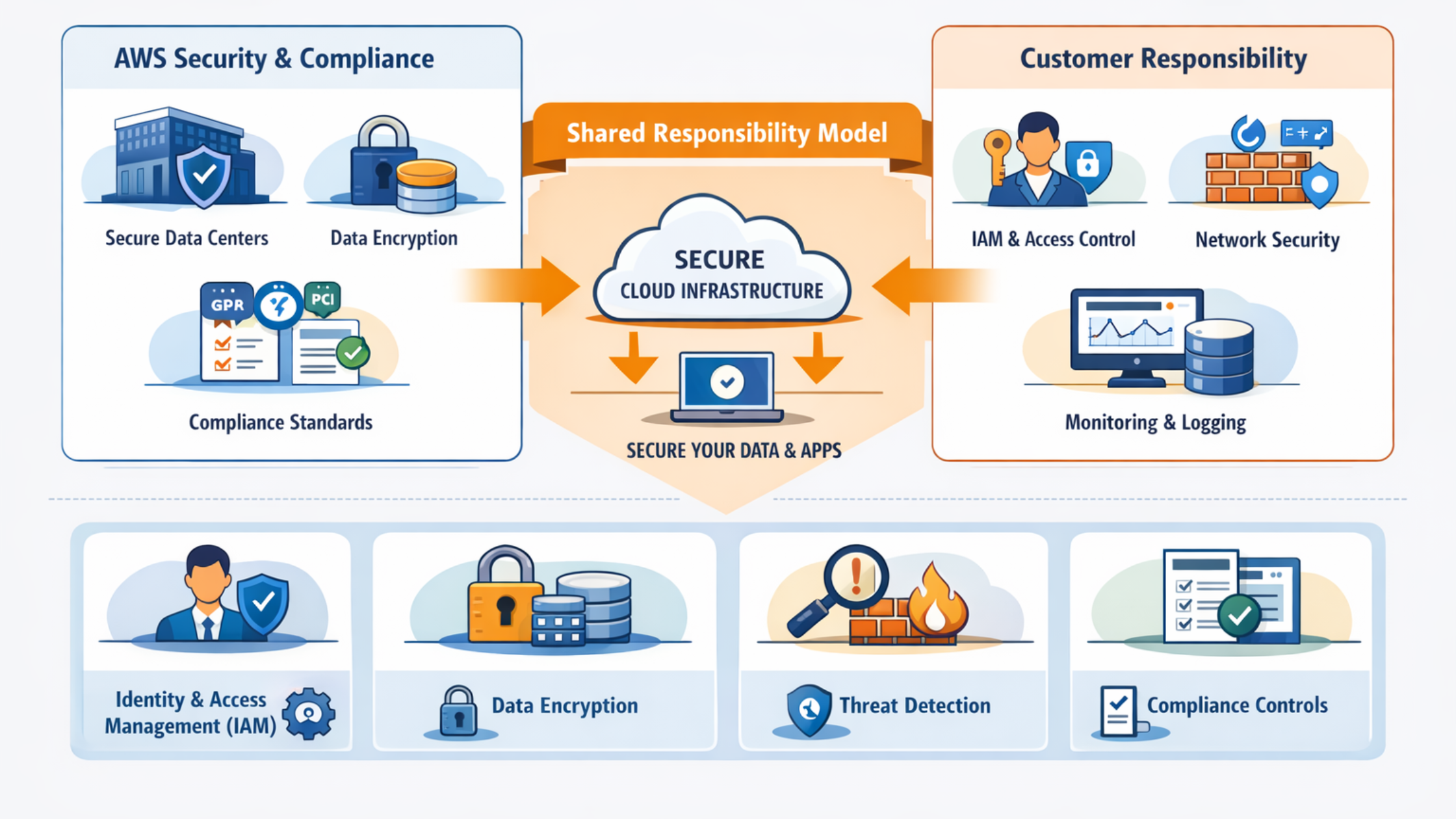
No. You (data controller) remain liable under DPDP Act Section 2(d). AWS is a processor; it ensures infrastructure security via DPA and certification. You must implement governance (consent, DPO, DPIA). Techtweek acts as your compliance partner, not your legal liable party.
What happens if we fail a CERT-In DPDP audit?
CERT-In may issue show-cause notices and recommend remediation within 30–60 days. Repeated non-compliance can trigger penalties under relevant cybersecurity laws (ITA 2000, DPDP Act penalties TBD). Techtweek’s quarterly audits help you stay audit-ready.
Read the full guide: Compliance Management.