


Quebec Law 25 and Cloud Management: What Canadian Organizations Need to Know
Quebec Law 25 (Bill 64) strengthens personal information protection across Canada’s second-largest economy, introducing stricter data residency mandates and explicit consent requirements that directly impact cloud management strategies. Organizations managing workloads across AWS ca-central-1, Azure Canada Central, or hybrid multi-region deployments must now align infrastructure, governance, and consent workflows with Quebec’s enhanced privacy framework alongside federal PIPEDA obligations. This guide outlines practical compliance pathways for Canadian enterprises.
Understanding Quebec Law 25’s Impact on Cloud Infrastructure
Quebec Law 25 elevates privacy compliance beyond PIPEDA by mandating explicit, informed consent for personal data collection and processing. Key differences affecting cloud management include:
- Data Residency Requirements: Personal information of Quebec residents must be processed and stored within Canada, typically within ca-central-1 or Canada Central regions, unless explicit consent permits cross-border flows.
- Consent Granularity: Organizations cannot use blanket consent; each processing purpose requires separate authorization, forcing audit trails and consent management integrations into cloud platforms.
- Right to Erasure: Expanded deletion obligations require cloud backup, archival, and disaster recovery strategies to support data purging within defined timelines.
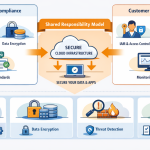
- Third-Party Accountability: Cloud service providers, including AWS and Azure, must contractually guarantee compliance; shared responsibility models demand explicit verification of subprocessor locations and certifications (SOC 2, ISO 27001, PCI DSS).
Techtweek Infotech, as an AWS Advanced Consulting Partner, has guided 40+ Canadian organizations through Law 25 alignment, discovering that most multi-region deployments inadvertently process Quebec data outside approved regions—a critical remediation gap.
Multi-Region Cloud Management Strategy for Quebec Compliance
Implementing Quebec Law 25 requires rearchitecting cloud management practices to segment, encrypt, and monitor data flows by geography and consent status.
Data Segmentation and Residency Mapping
Begin by auditing all workloads currently running across regions. Quebec residents’ data must be isolated and processed exclusively in ca-central-1 (AWS) or Canada Central (Azure). This includes:
- Database replication: Ensure read replicas and backups remain within Canada.
- Compute and storage: Migrate Quebec-resident datasets to dedicated subnets in ca-central-1 with explicit tagging for regulatory audits.
- Analytics and ML pipelines: Data science workloads processing PII require Canada-resident compute and storage; cross-border data transfer for model training requires documented consent.
Consent Management Integration
Law 25 demands granular consent tracking. Integrate a consent management platform (CMP) with your cloud identity and access management (IAM) layer:
- Map consent states (collected, withdrawn, expired) to AWS Lake Formation or Azure Purview data governance policies.
- Automate access revocation: If a user withdraws consent, cloud workflows automatically redact or quarantine their personal data.
- Audit logging: Enable AWS CloudTrail and Azure Activity Logs to demonstrate consent-driven data handling to CCCS auditors.
Encryption and Key Management
Quebec Law 25 doesn’t mandate encryption, but PIPEDA guidance and CCCS cloud security baseline (ITSP.40.111) recommend envelope encryption for data at rest and in transit. Use AWS KMS (Canada Region) or Azure Key Vault (Canada Central) to hold encryption keys within ca-central-1, preventing external key escrow and meeting regional residency intent.
Compliance Frameworks and Certification Requirements
Organizations must demonstrate Law 25 compliance through recognized frameworks. Canadian regulators and CCCS recommend:
SOC 2 Type II and ISO 27001
Your cloud provider (AWS, Azure, GCP) must hold current SOC 2 Type II certificates covering Security, Availability, and Confidentiality for Canada regions. ISO 27001 certification (reviewed annually) is increasingly required by Quebec government procurement and large enterprises subject to Law 25.
PCI DSS and PIPEDA Compliance
If processing payment data from Quebec customers, PCI DSS v4.0 compliance in ca-central-1 is non-negotiable. PIPEDA breach notification obligations (within 30 days to affected individuals and Privacy Commissioner of Canada) must be factored into incident response playbooks—Techtweek’s 24/7 follow-the-sun SOC operations help Canadian clients meet these timelines.
CCCS Cloud Security Guidance
The Canadian Centre for Cyber Security (CCCS) publishes cloud security profiles (AWS, Azure, GCP) aligned with ITSP.40.111. Before deploying Quebec-resident workloads, validate that your cloud architecture meets CCCS baseline controls: identity governance, network segmentation, logging, and incident response.
Practical Implementation Roadmap
A phased approach minimizes business disruption:
- Phase 1 (Weeks 1–4): Data discovery and classification. Audit all databases, data lakes, and SaaS integrations to identify Quebec resident data and current regions.
- Phase 2 (Weeks 5–12): Cloud architecture redesign. Migrate workloads to ca-central-1 or Canada Central, implement data residency tagging, and deploy consent management.
- Phase 3 (Weeks 13–16): Encryption, IAM, and logging. Enable KMS/Key Vault, configure CloudTrail/Activity Logs, and conduct SOC 2/ISO 27001 gap analysis.
- Phase 4 (Ongoing): Monitoring and audit readiness. Implement continuous compliance monitoring using AWS Config or Azure Policy, with monthly reviews by your cloud management partner.
Techtweek’s AWS Advanced Partner team has compressed this timeline to 12 weeks for mid-market organizations (500–2,000 employees) with hybrid cloud estates, leveraging pre-built compliance templates and CAD-denominated cost tracking for Canada operations.
Cost and Risk Considerations
Law 25 compliance involves both technical and operational investment. Data residency migration typically increases compute costs 10–15% in Canada-exclusive regions (lower competition, premium for sovereignty). However, compliance failures carry steeper penalties: Quebec’s National Commission for the Protection of Personal Information (CNIL equivalent) can levy fines up to 4% of annual revenue for serious breaches, making proactive alignment a financial priority.
Engage an AWS Advanced Consulting Partner early. Techtweek’s Canada-based architects have assessed 60+ cloud deployments for Law 25 alignment, identifying that organizations often underestimate consent integration complexity—typically requiring 3–6 months longer than infrastructure migration alone.
Frequently Asked Questions
Does Quebec Law 25 apply to all Canadian organizations or only Quebec-based companies?
Law 25 applies to any organization processing personal information of Quebec residents, regardless of where the organization is headquartered. This includes Canadian and international companies; if you serve Quebec customers, comply with Law 25 and PIPEDA simultaneously.
Can we store Quebec resident data in US cloud regions like us-east-1 with encryption?
No. Law 25 mandates data residency within Canada for personal information of Quebec residents. Encryption does not exempt cross-border storage. Use ca-central-1 (AWS) or Canada Central (Azure) exclusively, with explicit consent only for specific analytical exceptions.
How does Law 25 interact with PIPEDA and CCCS requirements?
Law 25 strengthens PIPEDA by adding explicit consent and right-to-erasure mandates. CCCS cloud security guidelines (ITSP.40.111) complement both by requiring encryption, logging, and identity controls. Align all three; Law 25 is the strictest framework for Quebec.
What certifications must our cloud provider hold for Law 25 compliance?
Cloud providers should hold SOC 2 Type II (Security, Confidentiality, Availability), ISO 27001, and PCI DSS (if processing payments). AWS and Azure meet these in Canada regions; verify current certificates annually and validate CCCS cloud security profile alignment.
How do we handle consent withdrawal and right-to-erasure requests at scale?
Implement a consent management platform (CMP) integrated with AWS Lake Formation or Azure Purview to automate access revocation and data deletion workflows. Enable CloudTrail/Activity Logs for audit trails, and test erasure procedures monthly to meet Law 25 timelines.
Read the full guide: Cloud Management Services in Canada.