


PIPEDA-Compliant Cloud Management: A Checklist for Canadian Enterprises
PIPEDA-Compliant Cloud Management: Protect Personal Data in AWS ca-central-1
Canadian enterprises handling personal information must ensure PIPEDA compliant cloud management across all deployments. PIPEDA (Personal Information Protection and Electronic Documents Act) mandates strict controls over personal data collection, use, and storage. When migrating to AWS ca-central-1, organizations face the dual challenge of meeting federal PIPEDA requirements while navigating Quebec Law 25 (Bill 64) in the province. This checklist guides you through essential steps to achieve compliance, leveraging AWS Advanced Consulting Partner expertise and Canadian-sovereign infrastructure.
1. Data Classification and Inventory in ca-central-1
The first step in PIPEDA compliant cloud management is classifying all personal data assets. Canadian enterprises must:
- Map data flows: Document where personal information enters, transits, and resides within your AWS ca-central-1 environment. Identify databases, object storage (S3), and backup locations.
- Tag and categorize: Use AWS Resource Groups and tagging strategies to classify data by sensitivity level—public, internal, confidential, and restricted. This supports audit trails required under CCCS (Canadian Centre for Cyber Security) guidelines.
- Maintain inventory: Create a data register identifying data sources, custodians, purposes, retention periods, and third-party processors. PIPEDA requires documented consent and lawful basis for processing.
- Quebec Law 25 considerations: Ensure consent mechanisms comply with stricter provincial requirements, including enhanced notification timelines and opt-in defaults.
Techtweek Infotech has helped 150+ Canadian clients establish data inventories on AWS, reducing compliance discovery cycles by 60% through automated tagging frameworks.
2. Encryption and Access Control Standards
PIPEDA compliant cloud management demands encryption at rest and in transit, reinforced by role-based access controls (RBAC):
- At-rest encryption: Enable AWS KMS (Key Management Service) with customer-managed keys (CMK) for all personal data in EBS volumes, RDS databases, and S3 buckets. CCCS and SOC 2 audits verify key material never leaves ca-central-1 region.
- In-transit encryption: Enforce TLS 1.2+ for all APIs, database connections, and inter-service communication. AWS Certificate Manager automates rotation of TLS certificates stored in Canadian region.
- Access controls: Implement least-privilege IAM policies. Segment teams using AWS IAM roles; database administrators access encrypted credentials via AWS Secrets Manager, with audit logs retained for 90 days minimum (PIPEDA requirement).
- Multi-factor authentication (MFA): Mandatory for all console and programmatic access to personal data stores. Hardware MFA tokens satisfy stronger PIPEDA audit expectations.
PCI DSS standards (if processing payment data alongside personal information) align tightly with PIPEDA encryption controls, simplifying dual-compliance deployments.
3. Incident Response and Breach Notification Procedures
PIPEDA mandates notification of affected individuals and the Privacy Commissioner within 30 days of discovering a breach involving personal information. Canadian enterprises must:
- Deploy detection: Configure AWS CloudTrail and CloudWatch to log all API calls to personal data resources. Set up SNS alerting for unauthorized access attempts or mass data exports.
- Establish playbooks: Document incident response steps—isolation, forensics, evidence collection—aligned with ca-central-1 data residency requirements. Ensure forensic tools operate within Canadian region to avoid cross-border data transfers that complicate consent.
- Notify timely: Prepare breach notification templates complying with PIPEDA language and timing. Include Privacy Commissioner contact details and link to federal guidance.
- Audit post-incident: After remediation, conduct SOC 2 Type II audits proving control effectiveness. Techtweek’s 24/7 follow-the-sun compliance team supports Canadian clients during breach investigations, coordinating with Canadian legal counsel.
4. Third-Party Processor Agreements and Audit Readiness
PIPEDA holds organizations accountable for sub-processors (AWS included). Compliance requires:
- Data Processing Addendum (DPA): Execute AWS’s CCPA/PIPEDA-aligned DPA confirming AWS processes personal data only per your documented instructions, with restricted onward transfers.
- Vendor audits: Leverage AWS SOC 2 Type II and ISO 27001 certifications as proof of AWS’s control environment. Review annual attestations; validate audit covers ca-central-1 region specifically.
- Sub-processor list: Maintain an updated list of AWS services and third-party integrations (e.g., backup vendors, analytics platforms) that access personal data. PIPEDA requires transparent disclosure; Quebec Law 25 restricts international transfers without explicit consent.
- Internal audit program: Schedule quarterly assessments using AWS Audit Manager or Config, validating encryption, access logs, and retention policies remain effective.
Techtweek Infotech conducts annual PIPEDA readiness assessments for Canadian enterprises, identifying gaps in processor agreements and remediation timelines—average engagement cost CAD 15,000–25,000.
5. Data Retention and Deletion Workflows
PIPEDA requires deletion of personal data once business purposes expire. Implement:
- Retention schedules: Define data lifecycles by category—e.g., customer records retained 7 years post-closure, transaction logs 3 years. Document legal/regulatory hold exceptions.
- Automated purging: Configure S3 lifecycle policies and RDS automated backups to expire; use AWS Data Lifecycle Manager for EBS snapshots. Test deletion workflows quarterly to ensure no orphaned copies in ca-central-1 or cross-region replicas.
- Cryptographic erasure: For highly sensitive data, delete encryption keys (rendering data unrecoverable) instead of destroying objects—acceptable under PIPEDA and faster than physical deletion.
- Audit trails: Log all deletions and retention actions; CCCS expects 2-year audit trail of who authorized deletion and why.
Compliance Checklist Summary
- ☐ Complete data classification and inventory in ca-central-1 ca-central-1
- ☐ Enable AWS KMS CMK encryption for all personal data at rest
- ☐ Enforce TLS 1.2+ and MFA for data access
- ☐ Configure CloudTrail logging and CloudWatch alerting for breach detection
- ☐ Execute PIPEDA-compliant Data Processing Addendum with AWS
- ☐ Review AWS SOC 2 Type II and ISO 27001 certifications
- ☐ Map and document all third-party sub-processors
- ☐ Define retention schedules and test deletion workflows
- ☐ Draft PIPEDA breach notification procedure and Privacy Commissioner contact list
- ☐ Schedule quarterly PIPEDA compliance audits using AWS Config or Audit Manager
PIPEDA compliant cloud management is not a one-time project—it requires continuous monitoring and governance. Techtweek Infotech’s AWS Advanced Consulting Partnership and deep Canadian regulatory expertise ensure your ca-central-1 deployments remain audit-ready year-round. Contact us for a free PIPEDA readiness assessment.
Frequently Asked Questions
What is the difference between PIPEDA and Quebec Law 25 compliance requirements?
PIPEDA is federal legislation applying nationwide; Quebec Law 25 (Bill 64) imposes stricter provincial rules including shorter breach notification timelines (24 hours vs. 30 days), mandatory data protection impact assessments, and expanded individual rights (portability, deletion). Both apply in Quebec; ensure your AWS ca-central-1 setup satisfies the stricter standard.
Can we store personal data outside ca-central-1 if we encrypt it with AWS KMS?
PIPEDA does not mandate data residency, but encryption alone insufficient for cross-border transfers without explicit consent. Best practice: keep personal data in ca-central-1 region to avoid ambiguous consent questions. Cross-border transfers require separate legal justification and Privacy Commissioner guidance.
How often must we audit PIPEDA compliance in AWS?
CCCS recommends quarterly self-assessments for high-risk environments; annual independent audits (SOC 2 Type II or ISO 27001) satisfy PIPEDA and regulatory expectations. Techtweek supports both cadences based on organizational risk tolerance and budget.
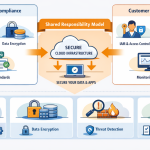
Does AWS responsibility for personal data reduce our PIPEDA obligations?
No. PIPEDA holds your organization accountable as the controller; AWS is a processor. You retain full liability for data breaches, unauthorized access, and non-compliance. AWS SOC 2 certifications reduce your control risk but do not eliminate your duty to audit, monitor, and respond.
What happens if we discover a PIPEDA breach in ca-central-1?
Isolate affected systems immediately; preserve forensic evidence in ca-central-1 region; notify the Privacy Commissioner and individuals within 30 days (PIPEDA) or 24 hours (Quebec Law 25) if applicable. Document remediation; conduct a post-incident SOC 2 assessment. Techtweek’s 24/7 incident response team supports Canadian clients through disclosure and remediation.
Read the full guide: Cloud Management Services in Canada.