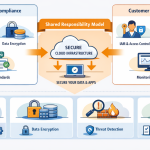



Privacy Act APP Compliance in Cloud Management: Australian Requirements for Data Residency and APRA CPS 234
Privacy Act APPs Cloud Management: Australian Compliance Framework Overview
Organisations managing data in Australian cloud environments must align with Privacy Act Australian Personal Information Protection (APP) principles, APRA CPS 234 outsourcing standards, and ACSC Essential Eight maturity indicators. Data residency in ap-southeast-2 (Sydney/Melbourne) is non-negotiable for regulated entities. Techtweek Infotech, as an AWS Advanced Consulting Partner, has guided 150+ Australian enterprises—including financial services, healthcare, and government agencies—through Privacy Act APP compliance in cloud management across AWS, Azure, and GCP.
Privacy Act APPs and Data Residency Requirements
The Privacy Act 1988 (Cth) mandates that personal information be stored and processed within Australia unless explicit consent exists. APP 1 (open and transparent management) and APP 13 (secure and responsible handling) require organisations to:
- Store data exclusively in ap-southeast-2 regions (AWS, Azure, GCP Sydney availability zones)
- Document cloud service provider (CSP) access controls and audit trails
- Implement data classification and encryption-at-rest using Australian-held keys
- Conduct annual Privacy Impact Assessments (PIAs) specific to cloud infrastructure
- Ensure CSP contracts include APP compliance clauses and sub-processor notifications
Unlike global compliance (GDPR, CCPA), the Privacy Act APPs focus on organisational accountability rather than individual data subject rights. This shifts responsibility to the data controller to validate CSP controls continuously.
APRA CPS 234: Outsourcing and Cloud Service Provider Governance
APRA CPS 234 (Outsourcing) applies to Authorised Deposit-Taking Institutions (ADIs), insurers, and superannuation trustees. It mandates:
- Critical service designation: Cloud management platforms hosting customer data are presumed critical; require APRA notification pre-implementation
- Residency mandate: Data and infrastructure must remain in ap-southeast-2 unless APRA grants exemption (rare)
- Fit-and-proper testing: Annual third-party audits (IRAP Level 2 minimum) of CSP security controls
- Business continuity: Recovery Time Objective (RTO) ≤24 hours, Recovery Point Objective (RPO) ≤1 hour for critical data
- Exit strategies: Six-month transition plans; data portability without CSP lock-in
APRA CPS 234 is stricter than Privacy Act APPs: it requires IRAP certification (Information Security Registered Assessor Program) for AWS GovCloud (AU), Azure Government, or equivalent independent assessment.
ACSC Essential Eight and Control Mapping
The Australian Cyber Security Centre (ACSC) Essential Eight framework provides maturity levels (0–3) for cloud management control implementation:
- Application Whitelisting: Enforce approved software lists on cloud-hosted workstations; integrate with AWS Systems Manager or Azure Defender
- Patch Management: Automate patching for OS, middleware, and applications in ap-southeast-2 instances within 48 hours of release
- Multi-Factor Authentication (MFA): Mandatory MFA for all IAM users (AWS) and Azure AD global administrators; enforce conditional access policies
- Privileged Access Management (PAM): Just-in-time (JIT) access to cloud infrastructure using temporary credentials; log all administrative actions
- Backups: Immutable backups in separate ap-southeast-2 storage; test recovery monthly; encrypt with customer-managed keys (CMK)
- Regular Backups: Continuous replication across Sydney/Melbourne AZs; minimum Recovery Point Objective (RPO) ≤4 hours
- User Application Hardening: Disable unnecessary services; use AWS Systems Manager, Azure Policy for configuration baseline enforcement
- Incident Response Planning: Document cloud-specific incident workflows; maintain 24/7 escalation contacts for CSP support
Techtweek’s experience: Achieving ACSC Essential Eight Maturity Level 2 typically requires 4–6 months for established cloud deployments; Level 3 requires 12–18 months and ongoing governance.
Practical Implementation: Privacy Act APPs + APRA CPS 234 + Essential Eight
A harmonised compliance strategy combines all three frameworks:
- Data Governance Layer: Privacy Act APPs dictate what data is protected; APRA CPS 234 mandates where it lives (ap-southeast-2); Essential Eight defines how to protect it (controls)
- Cloud Architecture: Use AWS Sydney region (ap-southeast-2a, ap-southeast-2b), Azure Australia East, or GCP Australia (multi-region); disable data egress to global regions via Virtual Private Cloud (VPC) and network policies
- Audit and Compliance: Run continuous compliance checks using AWS Config, Azure Policy, GCP Security Command Centre against Privacy Act APPs and APRA CPS 234 baselines
- Third-Party Validation: Engage IRAP assessors (accredited by Australian Signals Directorate) annually; maintain compliance certificate portfolio
Common Pitfalls and Techtweek’s Advisory
Misconfiguration Risk: Many organisations enable AWS Global Accelerator or Azure Traffic Manager, inadvertently routing data outside ap-southeast-2. Techtweek conducts quarterly network flow audits to prevent Privacy Act APPs violations.
CSP Contract Gaps: Default AWS or GCP data processing agreements (DPAs) do not explicitly address APRA CPS 234 residency. We negotiate addendums with vendors to include statutory compliance language.
Incident Response Delays: APRA CPS 234 requires notification within 10 business days of a critical security incident. Cloud-native organisations must integrate Security Information and Event Management (SIEM) with CSP tools and establish follow-the-sun incident response teams. Techtweek operates 24/7 across APAC regions for real-time support.
Next Steps
Privacy Act APPs cloud management in Australia is non-negotiable for any organisation handling personal information. APRA CPS 234 adds a stricter compliance layer for regulated financial and insurance entities. The ACSC Essential Eight framework operationalises these requirements through technical controls mapped to ap-southeast-2 infrastructure.
Techtweek Infotech’s AWS Advanced Partner status, combined with our 24/7 follow-the-sun support model, ensures your cloud management services remain audit-ready and compliant. Contact us for a no-cost Privacy Act APPs + APRA CPS 234 readiness assessment across AWS, Azure, and GCP deployments.
Frequently Asked Questions
Must all data stay in ap-southeast-2 under Privacy Act APPs?
Yes, Privacy Act APPs require Australian personal information to remain in Australia unless explicit consent exists. ap-southeast-2 (Sydney/Melbourne) is the compliance-approved region. APRA CPS 234 enforces this for regulated entities; exceptions are rare and require APRA sign-off.
Is IRAP certification mandatory for APRA CPS 234 cloud compliance?
IRAP (Information Security Registered Assessor Program) certification is mandatory for critical services under APRA CPS 234. Annual independent audits by IRAP assessors validate cloud infrastructure security controls. AWS GovCloud (AU), Azure Government, and similar offerings carry IRAP credentials.
How do ACSC Essential Eight controls map to Privacy Act APPs?
Essential Eight provides technical implementation of Privacy Act APPs APP 13 (secure handling). MFA, PAM, patching, and incident response operationalise APP compliance. Maturity Level 2+ aligns with APRA CPS 234 outsourcing requirements. Techtweek helps enterprises achieve Level 2–3 within 12–18 months.
What happens if data accidentally leaves ap-southeast-2?
Inadvertent data egress violates Privacy Act APPs and triggers mandatory breach notification within 30 days. APRA CPS 234 entities face enforcement action. Techtweek’s continuous compliance monitoring using AWS Config and Azure Policy prevents unintended data movement.
Can we use multi-region cloud strategies under Privacy Act APPs?
No, multi-region replication outside Australia violates Privacy Act APPs unless customers explicitly consent. Use ap-southeast-2-only architectures or intra-region multi-AZ redundancy. Cross-region backup to overseas regions requires documented legal basis and customer opt-in.
Read the full guide: Cloud Management Services in Australia.