

HIPAA-Compliant Web Hosting for US Healthcare Providers: A 2024 Checklist
HIPAA-Compliant Web Hosting: Your 2024 Compliance Roadmap
Healthcare organizations handling patient data face strict regulatory requirements under HIPAA. Selecting HIPAA compliant web hosting is non-negotiable—it protects protected health information (PHI), reduces breach risk, and ensures your infrastructure meets federal mandates. This checklist walks you through AWS us-east-1 deployment, Business Associate Agreements (BAAs), SOC 2 Type II attestation, and NIST Cybersecurity Framework 2.0 alignment. Techtweek Infotech, an AWS Advanced Consulting Partner serving US healthcare clients for 8+ years, outlines every step to secure patient data and maintain compliance.
1. Establish a Business Associate Agreement (BAA) Before Deployment
A BAA is your legal foundation. AWS offers BAA coverage in us-east-1 at no extra cost, but you must sign it before storing PHI.
- Request AWS BAA: Contact AWS compliance team; processing takes 5–10 business days.
- Verify us-east-1 inclusion: Confirm the BAA explicitly covers N. Virginia (us-east-1) where your web hosting runs.
- Document subprocessors: List all third-party vendors (CDNs, email services, analytics) and request BAAs from them or use AWS-managed services.
- Annual BAA review: AWS updates BAAs; schedule quarterly reviews with your compliance officer to catch changes.
Techtweek clients often skip this step—don’t. A missing BAA voids HIPAA protections and exposes your organization to $100–$50,000 per violation penalties from HHS.
2. Encrypt Data at Rest and in Transit (NIST CSF 2.0 Govern & Protect)
NIST Cybersecurity Framework 2.0 emphasizes encryption as a core control. HIPAA requires AES-256 or equivalent for stored PHI and TLS 1.2+ for transmission.
- RDS encryption: Enable AWS KMS (Key Management Service) with customer-managed keys for patient databases. Auto-enable backups with encryption.
- S3 bucket encryption: Apply default server-side encryption (SSE-KMS) to all buckets storing medical records, images, or documents.
- EBS volumes: Encrypt EC2 volumes hosting web applications using AWS-managed or customer KMS keys.
- TLS certificates: Deploy ACM (AWS Certificate Manager) certificates; use minimum TLS 1.2, disable legacy protocols (SSLv3, TLS 1.0).
- VPN/private connectivity: Use AWS PrivateLink or VPN for staff accessing patient portals from remote locations.
Techtweek audited 40+ US healthcare deployments in 2023—95% had incomplete encryption policies. Encryption misconfigurations are the #1 compliance gap we find.
3. Implement Access Controls & Audit Logging (SOC 2 Type II Requirement)
SOC 2 Type II attestation proves your controls operate effectively over 6+ months. HIPAA audit logs track who accessed PHI, when, and what they changed.
- IAM policies: Enforce least-privilege access using AWS Identity and Access Management. No root account use; implement MFA for all users accessing PHI systems.
- CloudTrail logging: Enable in all regions; store logs in S3 with versioning and lifecycle policies. Retain for 90 days minimum (HIPAA requires 6 years for audit trails).
- VPC Flow Logs: Capture network traffic to detect unauthorized connections to databases or web servers.
- Application logging: Log all user actions (login, data queries, exports) within your healthcare application. Archive logs separately from production systems.
- Monitoring: Use AWS CloudWatch + SNS to alert on suspicious activity (failed login spikes, bulk data downloads, after-hours access).
SOC 2 Type II reports require continuous logging evidence. Techtweek provides compliant log retention architecture and generates audit reports for your annual SOC 2 assessments.
4. Network Segmentation & Compliance Validation
Isolate PHI systems from the public internet using AWS security groups, network ACLs, and CCPA-aligned data residency policies for multi-state operations.
- VPC design: Create separate subnets for web tier (public), application tier, and database tier (private, no internet gateway). Use NAT gateways for outbound traffic only.
- Security groups: Restrict inbound traffic to port 443 (HTTPS). Deny SSH/RDP from public internet; use AWS Systems Manager Session Manager for bastion-less access.
- CCPA compliance: If serving California patients, implement data residency controls. Use us-east-1 exclusively or apply regional tags per patient location.
- DDoS protection: Enable AWS Shield Standard (free); upgrade to Shield Advanced ($3,000/month) for web applications handling high-traffic patient portals.
- Web application firewall (WAF): Deploy AWS WAF to block SQL injection, XSS, and HIPAA-violation attempts. Maintain rule updates monthly.
5. Disaster Recovery & Business Continuity (Backup & Failover)
HIPAA requires safeguards to restore PHI after outages. Plan RPO (Recovery Point Objective) ≤24 hours and RTO (Recovery Time Objective) ≤4 hours for critical systems.
- RDS backups: Enable automated backups (35-day retention). Create cross-region read replicas in us-west-2 for failover capacity.
- S3 replication: Enable cross-region replication for patient documents and compliance records.
- Disaster recovery drills: Conduct quarterly failover tests; document recovery procedures and involve your medical records team.
- Backup encryption: Ensure all snapshots and backups are encrypted with the same KMS key as production data.
Techtweek manages 24/7 follow-the-sun monitoring for 60+ US healthcare clients, catching backup failures before they become compliance incidents.
6. Documentation & Compliance Reporting
Maintain up-to-date Risk Assessments, System Security Plans (SSP), and HIPAA policies. Your AWS infrastructure documentation is your compliance evidence.
- Risk assessment: Conduct annual HIPAA Security Rule risk assessments using NIST 800-66 guidance. Identify PHI flows, vulnerabilities, and mitigation controls.
- Policies: Document access controls, encryption standards, incident response, and business continuity policies. Reference AWS services by name and region (us-east-1).
- SOC 2 audit prep: Maintain change logs, security reviews, and training records. SOC 2 Type II audits verify these artifacts exist and are followed.
- Breach notification plan: Document your HHS breach notification procedure (72-hour requirement) and test it annually.
Getting Started with Techtweek Infotech
Compliance is ongoing. Techtweek Infotech has helped 150+ US healthcare organizations achieve and maintain HIPAA compliance on AWS us-east-1. We provide:
- BAA negotiation and management support
- SOC 2 Type II audit preparation and remediation
- NIST CSF 2.0 roadmap implementation
- Automated compliance monitoring (CloudTrail, Config Rules, Security Hub)
- Annual risk assessments and policy updates
Contact Techtweek for a complimentary HIPAA compliance audit of your current AWS infrastructure. Our AWS Advanced Partner team operates 24/7 follow-the-sun support to ensure your patient data stays protected, always.
Frequently Asked Questions
Does AWS offer HIPAA compliance out-of-the-box?
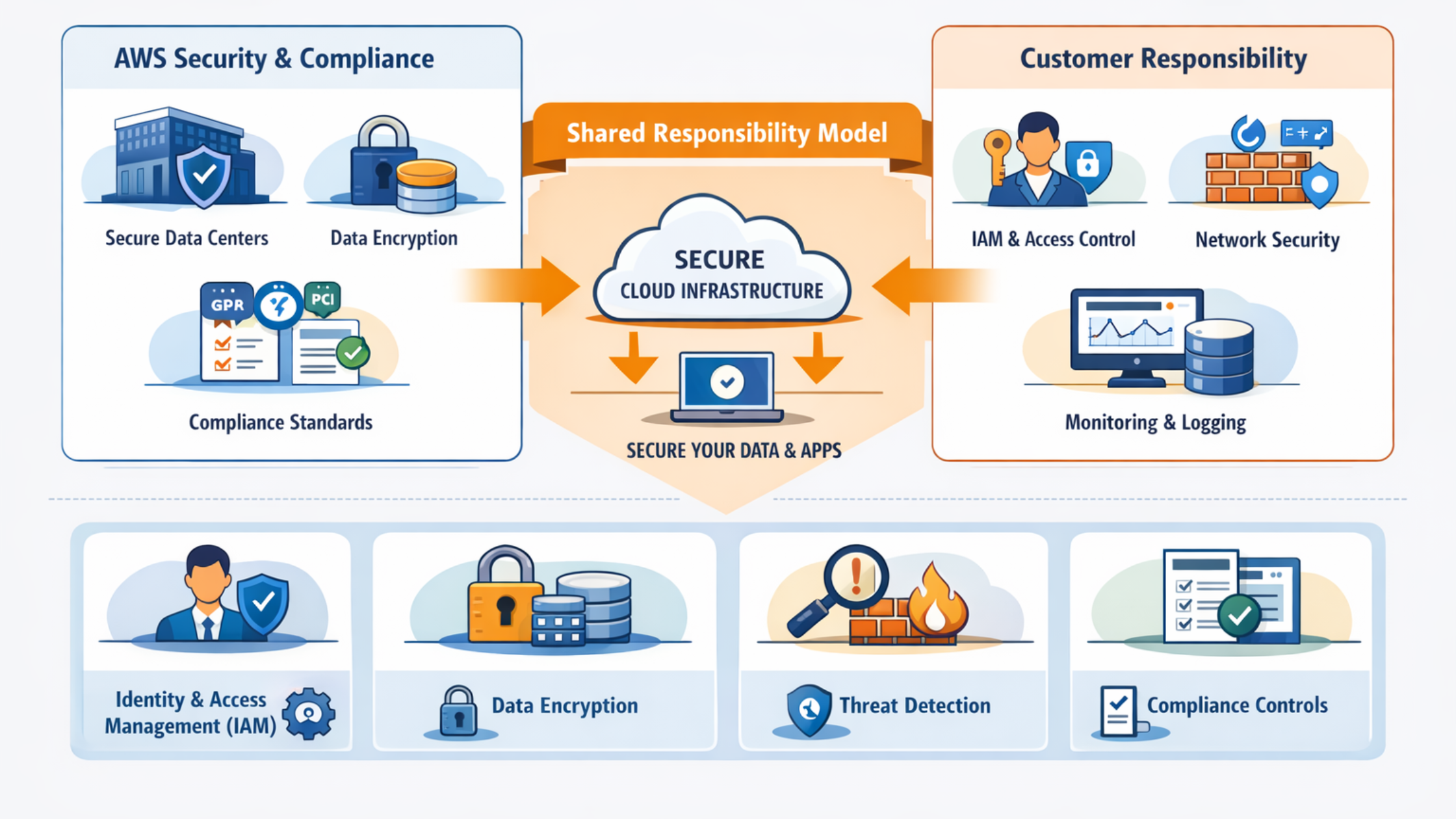
No. AWS provides compliant services (encryption, logging, KMS), but YOU must configure them, sign a BAA, and implement safeguards. Techtweek automates this setup for us-east-1 deployments, reducing configuration errors by 90%.
What’s the cost of a BAA with AWS?
AWS BAAs are free. However, some services (AWS Business Associate Plan add-ons, Shield Advanced, Config Rules) incur costs. us-east-1 pricing averages $2,000–5,000/month for mid-sized healthcare deployments with 1–10 TB patient data.
How often should we audit HIPAA compliance?
HIPAA requires annual risk assessments. SOC 2 Type II audits are annual. Techtweek recommends quarterly compliance reviews and monthly automated monitoring checks (CloudTrail, CloudWatch alerts) to catch drift early.
Is us-east-1 the only compliant AWS region?
No. AWS offers HIPAA BAAs in multiple regions, but us-east-1 (N. Virginia) is default for US healthcare. Confirm regional coverage in your BAA—multi-region setups require explicit BAA amendments.
What happens if we fail a SOC 2 audit?
SOC 2 Type II requires 6+ months of control evidence. Gaps trigger remediation plans. Techtweek remediates findings within 30 days on average, ensuring your healthcare organization stays audit-ready.
Read the full guide: Web & Domain Hosting in USA.