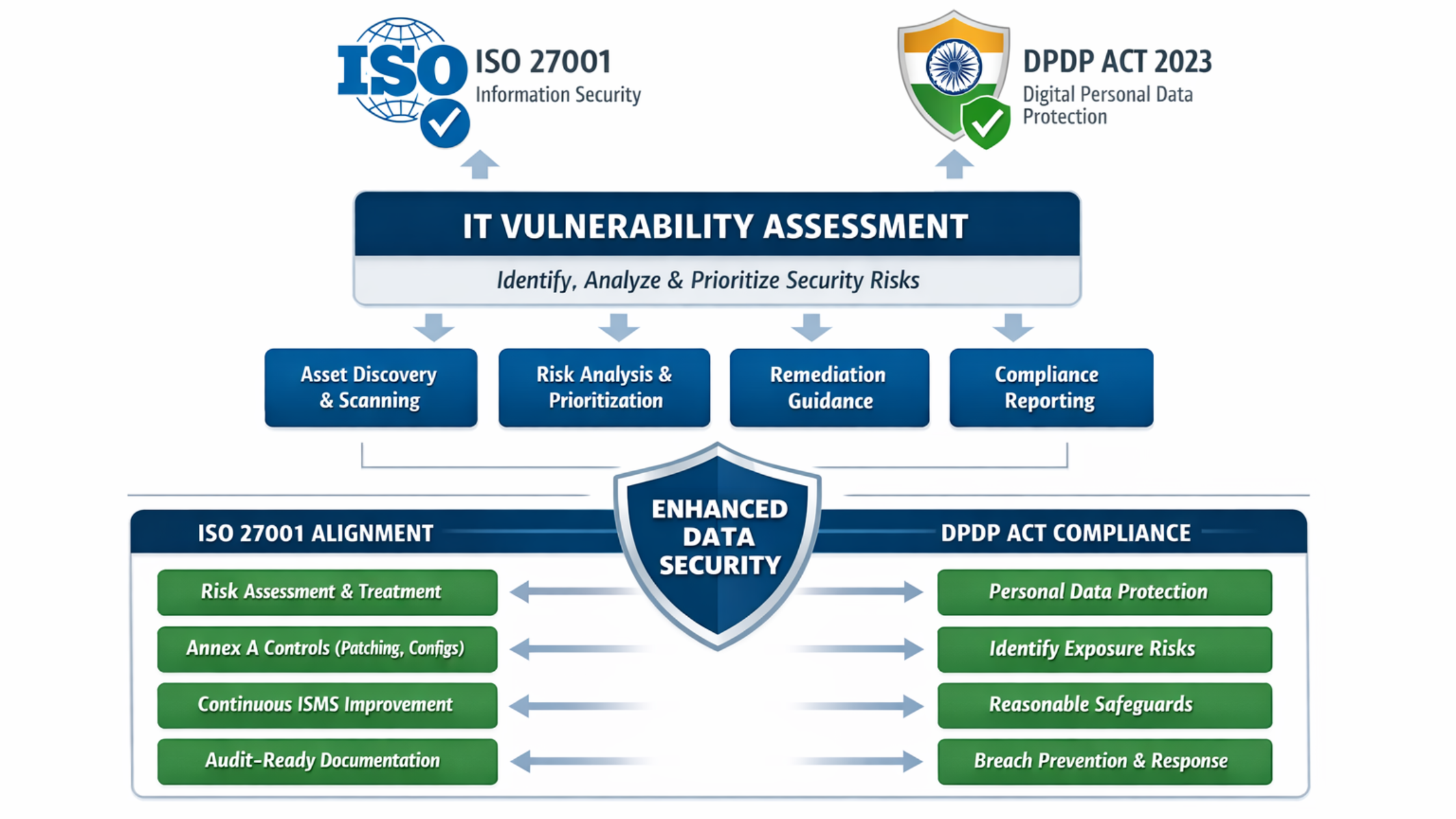
IT Vulnerability Assessment Services help organizations identify security weaknesses across networks, systems, applications, and cloud environments. These weaknesses, if left unaddressed, can lead to data breaches, compliance failures, and regulatory penalties. Both ISO/IEC 27001 and India’s DPDP Act, 2023 require organizations to proactively identify, manage, and reduce information security risks. Vulnerability assessment acts as a practical and measurable way to meet these requirements.
Identifying Information Security Risks
ISO 27001 is built on risk management, and the DPDP Act expects organizations to protect personal data from security threats. Vulnerability assessment helps identify technical weaknesses that could be exploited to access, alter, or leak sensitive and personal data. By scanning systems and infrastructure, organizations gain real visibility into where their security risks exist.
Key support areas:
- Detects vulnerabilities in servers, networks, cloud, and applications
- Identifies systems exposing personal or sensitive data
- Provides evidence-based risk inputs for ISMS and DPDP compliance
- Replaces assumptions with real security findings
Supporting ISO 27001 Risk Assessment & Treatment
ISO 27001 requires organizations to perform risk assessments and apply appropriate risk treatment measures. Vulnerability assessment supplies factual data that strengthens this process. Instead of theoretical risks, organizations can evaluate actual weaknesses, understand their impact, and decide whether to mitigate, accept, or transfer the risk.
How it helps ISO 27001:
- Feeds real vulnerability data into the risk register
- Helps prioritize risks based on severity and exploitability
- Supports documented risk treatment decisions
- Aligns technical risks with business impact
Strengthening Annex A Security Controls
Annex A of ISO 27001 includes controls related to secure configuration, patching, network security, and protection against known vulnerabilities. Vulnerability assessments validate whether these controls are working as intended. They also reveal gaps where controls are missing, misconfigured, or outdated.
Control-level benefits:
- Identifies missing patches and outdated software
- Detects insecure system and network configurations
- Validates effectiveness of technical security controls
- Supports preventive and corrective control actions
Enabling Continuous Improvement of ISMS
ISO 27001 emphasizes continuous improvement rather than one-time compliance. Vulnerability assessment supports this by providing ongoing insight into the organization’s security posture. Regular assessments allow organizations to track improvement, measure control effectiveness, and respond to emerging threats.
Continuous improvement support:
- Tracks vulnerability trends over time
- Measures reduction in risk exposure
- Supports corrective and preventive actions
- Demonstrates ISMS maturity to auditors
Protecting Personal Data Under DPDP Act
The DPDP Act requires organizations to safeguard personal data against unauthorized access and breaches. Vulnerability assessments help locate weak points where personal data may be exposed, such as misconfigured databases, open cloud storage, or vulnerable APIs.
DPDP-focused protection:
- Identifies systems storing or processing personal data
- Detects exposure risks in cloud and on-prem environments
- Reduces chances of personal data leaks
- Strengthens data protection controls
Demonstrating “Reasonable Security Safeguards”
The DPDP Act does not define exact security controls but expects reasonable safeguards based on risk. Vulnerability assessment helps organizations justify their security approach by showing that risks are identified, prioritized, and addressed according to their severity and impact.
How it proves reasonable safeguards:
- Prioritizes vulnerabilities affecting personal data
- Aligns remediation with risk levels
- Documents proactive security efforts
- Supports regulatory and legal defensibility
Reducing Breach Risk and Regulatory Exposure
Both ISO 27001 and the DPDP Act emphasize preventing security incidents and minimizing their impact. Regular vulnerability assessment reduces the attack surface and helps prevent breaches that could lead to financial penalties, reputational damage, and compliance violations.
Risk reduction outcomes:
- Lowers likelihood of successful cyberattacks
- Minimizes breach impact on sensitive data
- Demonstrates due diligence to regulators
- Reduces chances of non-compliance penalties
Supporting Audit Readiness & Evidence Collection
Auditors and regulators expect proof of ongoing security management. Vulnerability assessment reports act as strong evidence during ISO 27001 audits and DPDP compliance reviews. They show that security risks are actively monitored and addressed.
Audit & governance support:
- Provides documented vulnerability reports
- Shows remediation actions and timelines
- Supports internal and external audits
- Reduces audit findings and observations
Aligning Security, Compliance & Business Goals
Vulnerability assessment bridges the gap between technical security and business compliance. It helps leadership understand cyber risks in business terms and make informed decisions. This alignment is critical for long-term compliance and operational resilience.
Business-level alignment:
- Converts technical risks into business impact
- Improves management visibility and accountability
- Supports informed security investments
- Builds customer and stakeholder trust
Conclusion
IT Vulnerability Assessment Services are a core enabler for ISO 27001 and DPDP Act compliance. They help organizations identify real risks, protect personal data, strengthen security controls, and demonstrate accountability. By combining technical insight with compliance requirements, vulnerability assessment ensures that security is proactive, measurable, and continuously improving.