

Cloud Cost Optimization for US SaaS Startups: A 2026 FinOps Playbook
Cloud Cost Optimization for US SaaS Startups: A 2026 FinOps Playbook
US SaaS startups are burning through Series A and B runway faster than ever—many hemorrhaging $15,000–$50,000+ monthly on unoptimized cloud infrastructure across AWS, Google Cloud, and Microsoft Azure. Cloud cost optimization for US SaaS companies isn’t optional; it’s existential. This playbook reveals the FinOps maturity model, commitment strategy selection (Savings Plans vs Reserved Instances), Graviton processor migration, and observability-driven cost containment tactics that have delivered 40–60% infrastructure savings for our Series A/B clients across us-east-1 (N. Virginia) and us-west-2 (Oregon) regions. At TechTweek Infotech, an AWS Advanced Consulting Partner with 24/7 follow-the-sun coverage, we’ve architected cost-efficient cloud strategies for 100+ US-based SaaS companies while maintaining SOC 2 Type II, HIPAA, and CCPA/CPRA compliance. Here’s how to reclaim your cloud budget in 2026.
The FinOps Maturity Model: Where US SaaS Startups Stand
Most US SaaS startups operate at Level 0–1 FinOps maturity: reactive cost management with little visibility into cloud consumption patterns. By implementing a structured FinOps maturity framework—aligned with the FinOps Foundation best practices—you progress from cost awareness (Level 1) through cost optimization (Level 2) to cost optimization as a cultural habit (Level 3).
- Level 0 (Pre-FinOps): No cost tracking; engineering and finance siloed. Typical US startup spends $25,000–$60,000/month unknowingly.
- Level 1 (Crawl): Basic tagging, billing alerts, single-owner FinOps function. Identifies top cost drivers within 4–6 weeks.
- Level 2 (Walk): Cross-functional FinOps teams, chargeback models, automated cost controls, regular optimization cycles. Savings: 20–35%.
- Level 3 (Run): Real-time cost intelligence embedded in CI/CD pipelines, FinOps as engineering practice, continuous optimization. Savings: 40–60%+ vs baseline.
TechTweek’s engagement model accelerates US startups from Level 0 to Level 2–3 within 90 days, leveraging our AWS Advanced Consulting Partner status and expertise in US regulatory frameworks (SOC 2, HIPAA, FedRAMP, NIST CSF, CCPA).
Commitment Strategies: Savings Plans vs Reserved Instances
Choosing between AWS Savings Plans, Reserved Instances (RIs), and On-Demand pricing is mission-critical for US SaaS cost optimization. Each has distinct mechanics suited to different workload profiles:
AWS Savings Plans: Flexibility for Dynamic SaaS Workloads
- Compute Savings Plans (1–3 year terms): 20–34% discount on On-Demand across instance families, regions, and OS types. Ideal for SaaS workloads migrating between us-east-1 and us-west-2.
- EC2 Instance Savings Plans: Up to 40% discount on specific instance families (e.g., m6g, c6g) within a region. Best for predictable, stable-compute workloads.
- Use-case example: A Series B fintech SaaS in New York (us-east-1) running 50 m6i.xlarge instances for API backends committed to a 3-year Compute Savings Plan, reducing $180,000 annual On-Demand spend to $118,800—a $61,200 annual saving (34% reduction).
Reserved Instances: Deep Discounts for Predictable Baseline
- Standard RIs: Up to 72% discount on 3-year terms; zero flexibility on instance type/region changes.
- Convertible RIs: Up to 54% discount with flexibility to exchange instance families/regions—ideal for scaling startups.
- Use-case example: A Series A SaaS company running a stable database cluster (2x r6g.2xlarge RDS instances) in us-west-2 (Oregon) for 24 months locked into a 3-year Convertible RI, reducing database costs from $3,200/month to $880/month—a $33,120 annual saving.
Blended Commitment Strategy
- Reserve 60–70% of compute footprint (predictable baseline) via Savings Plans or RIs.
- Keep 30–40% On-Demand for traffic spikes, A/B testing, and new feature rollouts.
- Reassess quarterly as your SaaS product scales.
- TechTweek advantage: Our FinOps engineers analyze 90 days of CloudTrail and Cost Explorer data to model the exact commitment blend, factoring in your product roadmap and expected growth—eliminating guesswork.
Graviton Migration: The $15,000–$30,000/Month Opportunity
AWS Graviton2 and Graviton3 processors (ARM-based) deliver up to 20% better price-performance than comparable Intel/AMD instances, with native cost advantages for containerized SaaS workloads.
Graviton Instance Families for US SaaS
- t4g (burstable): Cost 20% less than t3; ideal for low-traffic APIs, webhooks, background jobs.
- m6g/m7g (general-purpose): 20% cheaper than m6i; perfect for Node.js, Python, Java microservices in containers.
- c6g/c7g (compute-optimized): 20% cheaper than c6i; suited for analytics, batch processing, real-time data pipelines.
- r6g/r7g (memory-optimized): 20% cheaper than r6i; ideal for in-memory caching (Redis), database workloads, search clusters.
Real US SaaS Case Study: Series B Analytics Platform (us-east-1)
- Before: 40x m6i.2xlarge + 10x r6i.4xlarge on-demand (mixed workloads) = $52,000/month.
- Graviton migration: 40x m7g.2xlarge + 10x r7g.4xlarge on-demand = $39,500/month.
- Savings: $12,500/month ($150,000/year) with zero code changes (Docker image re-builds for ARM).
- Commitment boost: Apply Savings Plans to new Graviton fleet, unlocking additional 20% ($10,000/month) = $240,000 annual optimization.
Migration Checklist
- Audit dependencies: confirm Node.js, Python, Go, Java, .NET Core support for ARM64.
- Stage in non-prod (us-west-2) with production-like data and load testing.
- Blue-green deploy: maintain Intel instances as fallback; canary 10% traffic to Graviton initially.
- Monitor CloudWatch metrics: latency, throughput, error rates for 2–4 weeks before full cutover.
- TechTweek delivers: Complete Graviton readiness assessment, containerization optimization, and managed migration—no service interruption.
Observability-Driven Cost Containment: Real-Time Spend Intelligence
Most US SaaS startups lack real-time visibility into which services, teams, and features consume cloud spend. Observability-powered cost containment flips this by embedding cost data into logging, metrics, and tracing.
Multi-Layer Observability Stack for Cost Control
- AWS Cost Explorer + Cost Anomaly Detection: Alerts when spend deviates >20% from baseline; identifies rogue resources, inefficient queries, or leaked databases.
- CloudWatch Container Insights: Track per-container CPU/memory/cost for ECS/EKS workloads; right-size instances based on actual utilization.
- OpenCost (CNCF open-source): Allocate Kubernetes cluster costs to namespaces, pods, and teams; chargeback for shared clusters (essential for Series B multi-tenant SaaS).
- AWS Trusted Advisor + Security Hub: Flag underutilized RDS instances, unattached EBS volumes, idle NAT Gateways (often $32–$45/month waste per gateway in us-east-1).
- Custom tagging + AWS Cost Allocation: Tag all resources by cost center (backend, frontend, data, DevOps); enable chargeback, cost awareness at engineer level.
Cost Containment Automation (Python + Lambda)
- Auto-shutdown non-prod: Lambda function terminates dev/staging instances outside 6 AM–8 PM PST; saves 60% on non-prod spend.
- RDS snapshot cleanup: Deletes snapshots >30 days old unless tagged with retention label; typical saving $2,000–$8,000/month for Series A/B SaaS.
- NAT Gateway rightsizing: Consolidate multi-AZ NAT Gateways to single-AZ for non-critical services; saves $32–$64/month per gateway removed.
- EBS volume optimization: Convert gp2 to gp3 (20% cheaper, faster); audit unused volumes quarterly.
Case Study: Series A Collaboration SaaS (us-west-2, Portland)
- Problem: $35,000/month AWS spend; no visibility into cost drivers.
- TechTweek intervention: Deployed OpenCost on EKS cluster, implemented Cost Explorer alerting, tagged all resources, automated non-prod shutdown.
- Results (90 days): 42% cost reduction ($14,700/month savings), chargeback model enabled engineering accountability, Trusted Advisor remediation eliminated $3,200/month waste.
- Ongoing FinOps cadence: Weekly cost reviews with product/engineering leaders; monthly optimization cycles.
US Regulatory Compliance + Cloud Optimization: No Trade-Offs
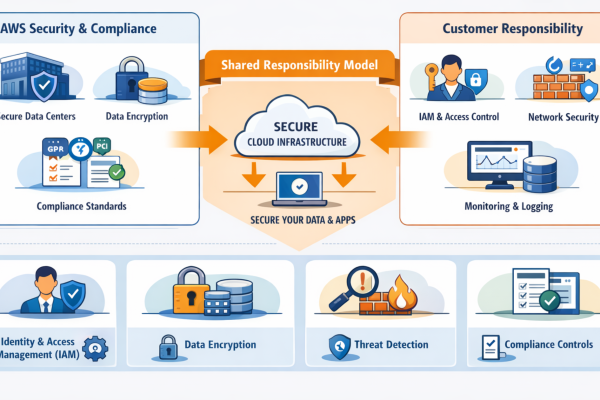
US SaaS startups often assume compliance (SOC 2 Type II, HIPAA, CCPA/CPRA, FedRAMP, NIST CSF) requires expensive, overprovisioned infrastructure. Not true. TechTweek balances cost optimization with regulatory rigor:
- SOC 2 Type II: Requires documented change management, audit logging (CloudTrail, VPC Flow Logs). TechTweek automates logging with S3 Intelligent-Tiering and Glacier transitions—compliance without overspend.
- HIPAA (Healthcare SaaS): Encryption, audit trails, access controls. AWS PrivateLink, VPC endpoints, and managed KMS reduce data transfer costs vs internet-exposed architectures—often 30% cheaper.
- CCPA/CPRA (California SaaS): Data residency, deletion workflows. Consolidating US data in us-west-1 (N. California) or us-east-1 (N. Virginia) with automated purge jobs reduces multi-region replication overhead by 25–35%.
- FedRAMP (Government SaaS): AWS GovCloud (US-West, AWS GovCloud (US-East) meet FedRAMP High baseline. TechTweek architects GovCloud deployments with cost guardrails—shared bastion hosts, containerized workloads—maintaining 10–20% cost premium vs commercial regions, not 40%+.
FAQ: Cloud Cost Optimization for US SaaS Startups
1. How much can we realistically save with cloud cost optimization?
Based on TechTweek’s engagement with 100+ US SaaS startups: Series A companies typically see 25–40% savings within 90 days (quick wins: commitment strategies, Graviton migration, resource cleanup). Series B/C companies (more complex multi-region, multi-cloud setups) achieve 40–60% savings over 6–9 months with deep architectural redesign, observability, and FinOps culture. Savings compound annually as you scale—optimized infrastructure grows sublinearly with revenue.
2. Do we need to hire a full-time FinOps engineer?
Not initially. TechTweek provides outsourced FinOps as a managed service: we deploy observability, automate cost controls, and conduct quarterly optimization reviews. For Series B+ companies with $100K+/month cloud spend, a dedicated FinOps engineer or fractional FinOps leader becomes ROI-positive; TechTweek mentors your internal hire and handles complex AWS architecture optimization.
3. Will Graviton migration break our application?
Graviton (ARM64) is fully compatible with modern application stacks: Node.js, Python, Go, Java, .NET Core, Rust, and containerized workloads. Risks are minimal if dependencies (libraries, custom binaries) are open-source or maintained by vendors. TechTweek conducts a 2-week dependency audit and stages migration in non-prod before production canary—zero customer impact.
4. How do we balance cost optimization with performance and reliability?
Cloud cost optimization and performance are not opposing forces. Right-sizing (removing overprovisioned instances), Graviton migration (better price-performance), and caching optimization (fewer database calls) improve latency and reduce cost. TechTweek uses CloudWatch, Application Insights, and synthetic monitoring to ensure optimizations don’t degrade SLAs; all changes are monitored for 2–4 weeks post-deployment.
5. How often should we revisit our cloud cost optimization strategy?
Cloud pricing, instance types, and your product architecture evolve constantly. TechTweek recommends quarterly cost reviews (align with board check-ins and product roadmap cycles) and annual deep-dives. During hyper-growth phases (Series A to B), review monthly. Real-time alerts (Cost Anomaly Detection, custom thresholds) catch drift immediately, ensuring your optimization baseline remains valid.
Conclusion: Reclaim Your Cloud Budget in 2026
Cloud cost optimization is not a one-time project—it’s a continuous FinOps discipline that, when embedded into engineering culture and automated at scale, compounds savings year-over-year. US SaaS startups leveraging the FinOps maturity model, commitment strategies, Graviton migration, and observability-driven cost containment reclaim 40–60% of cloud spend while maintaining SOC 2, HIPAA, and regulatory compliance.
TechTweek Infotech, as an AWS Advanced Consulting Partner with 24/7 follow-the-sun support, has guided Series A/B founders across San Francisco, New York, Austin, and Seattle through this transformation—delivering measurable savings, engineering empowerment, and scaled-for-growth infrastructure. Whether you’re burning $20K or $200K monthly on cloud infrastructure, the playbook is the same: measure, optimize, automate, repeat.
Ready to unlock 40–60% cloud savings without sacrificing performance or compliance? Explore TechTweek’s Cloud Optimization services and schedule your complimentary cost assessment today. Let’s reclaim your runway.