

How Windows Server Management Services Improve Security, Performance & Compliance in 2026
In 2026, businesses depend heavily on Windows servers to run critical applications, store sensitive data, and support daily operations. From file servers and databases to ERP systems and cloud workloads, Windows Server remains the backbone of enterprise IT infrastructure.
However, managing Windows servers has become more complex than ever. Cyber threats are increasing, performance expectations are higher, and regulatory compliance requirements are stricter. This is where Windows Server Management Services play a vital role.
Windows Server Management Services help organizations maintain secure, high-performing, and compliant server environments without operational stress. These services combine proactive monitoring, automation, security hardening, and compliance controls to ensure servers run smoothly 24/7.
In this blog, we will explore how Windows Server Management Services improve security, performance, and compliance in 2026, and why businesses are increasingly relying on managed services instead of handling everything in-house.
The Growing Importance of Windows Server Management Services in 2026
Modern IT environments are no longer limited to on-premise servers. Most organizations now operate hybrid or multi-cloud environments, combining on-prem Windows Servers with Microsoft Azure, AWS, and third-party platforms.
Managing this complexity manually increases the risk of:
- Security vulnerabilities
- Downtime and performance issues
- Compliance failures
- High operational costs
Windows Server Management Services provide centralized control, automation, and expert oversight, allowing businesses to focus on growth instead of server maintenance.
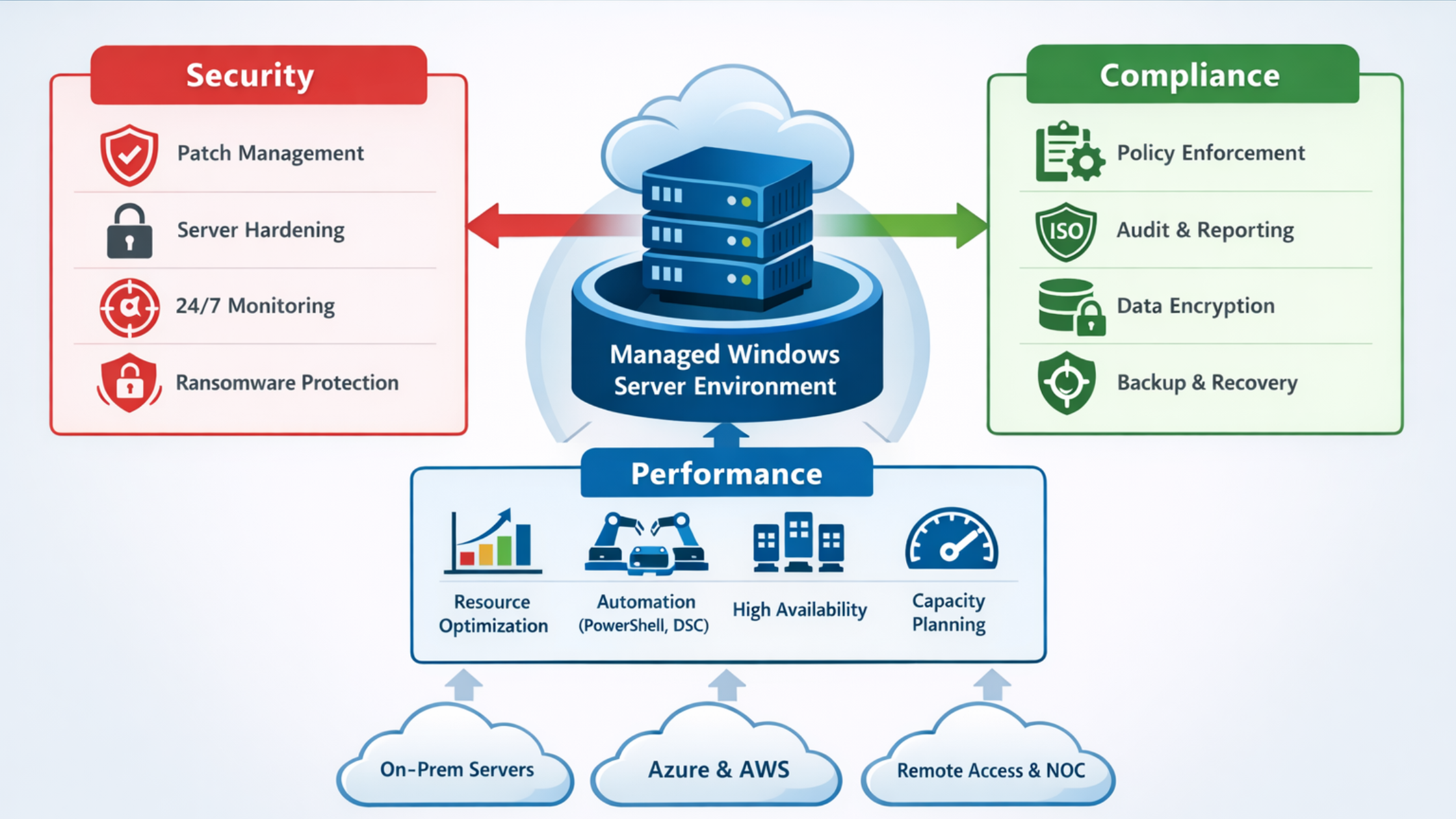
How Windows Server Management Services Improve Security
Security is the top concern for organizations in 2026. Ransomware attacks, zero-day vulnerabilities, insider threats, and misconfigurations are common causes of data breaches. Windows Server Management Services address these challenges through proactive and layered security practices.
Proactive Patch Management & Vulnerability Remediation
Unpatched servers remain one of the biggest security risks. Windows Server Management Services ensure that security patches and updates are applied on time without disrupting operations.
They help by:
- Monitoring Microsoft security advisories continuously
- Testing patches before deployment
- Applying critical updates during planned maintenance windows
- Reducing exposure to zero-day vulnerabilities
This proactive approach minimizes the attack surface and protects servers from known exploits.
Server Hardening & Secure Configuration Management
Default Windows Server configurations are not secure enough for production environments. Managed services apply security hardening techniques to strengthen server defenses.
These services improve security by:
- Disabling unnecessary services and ports
- Enforcing strong password and authentication policies
- Implementing role-based access control (RBAC)
- Applying Group Policy best practices
Secure configurations significantly reduce the risk of unauthorized access and lateral movement within networks.
24/7 Monitoring & Threat Detection
Modern attacks often go unnoticed for weeks. Windows Server Management Services provide continuous monitoring to detect threats early.
Security improvements include:
- Real-time log monitoring and alerting
- Detection of abnormal login attempts and suspicious behavior
- Integration with SIEM and SOC platforms
- Immediate incident response actions
Early detection helps organizations contain threats before they cause serious damage.
Ransomware & Malware Protection
Ransomware remains a major threat in 2026. Managed Windows Server environments implement layered defenses to prevent malware infections.
These services protect servers by:
- Enabling endpoint protection and anti-malware tools
- Restricting administrative privileges
- Monitoring file integrity and unusual encryption activity
- Ensuring reliable backups for fast recovery
This approach reduces downtime and prevents data loss during attacks.
How Windows Server Management Services Improve Performance
High server performance is critical for user experience, business productivity, and customer satisfaction. Poorly managed servers often suffer from slow response times, crashes, and unplanned downtime.
Windows Server Management Services improve performance through proactive optimization and intelligent monitoring.
Continuous Performance Monitoring & Optimization
Managed services monitor server health in real time to identify performance bottlenecks before users notice them.
They help improve performance by:
- Tracking CPU, memory, disk, and network usage
- Identifying resource-heavy applications
- Optimizing server workloads
- Preventing system overloads
Continuous monitoring ensures stable and consistent performance across all servers.
Capacity Planning & Resource Optimization
As businesses grow, server resource requirements change. Poor capacity planning leads to over-provisioning or performance degradation.
Windows Server Management Services improve capacity planning by:
- Analyzing usage trends
- Forecasting future resource needs
- Scaling servers proactively
- Reducing unnecessary infrastructure costs
This ensures servers are always right-sized for business needs.
Automation for Faster Operations
Manual server management is slow and error-prone. Automation is a key trend in 2026.
Managed services use automation tools such as:
- PowerShell scripting
- Desired State Configuration (DSC)
- Automated health checks
- Self-healing processes
Automation improves performance consistency and reduces downtime caused by human errors.
High Availability & Downtime Reduction
Downtime directly impacts revenue and reputation. Windows Server Management Services focus on availability and resilience.
They improve uptime by:
- Implementing failover clustering
- Monitoring critical services
- Ensuring proper load balancing
- Testing disaster recovery plans
This ensures business continuity even during failures.
How Windows Server Management Services Support Compliance
Compliance requirements are becoming stricter across industries. Standards like ISO 27001, PCI DSS, HIPAA, GDPR, and DPDP Act 2023 demand strong security controls, logging, and documentation.
Windows Server Management Services play a crucial role in meeting these requirements.
Policy Enforcement & Configuration Compliance
Compliance requires consistent security configurations across all servers. Managed services enforce standardized policies.
They help by:
- Applying baseline security configurations
- Ensuring uniform access controls
- Preventing unauthorized changes
- Maintaining configuration consistency
This reduces compliance gaps caused by misconfigurations.
Audit Logging & Reporting
Regulatory audits require detailed logs and reports. Windows Server Management Services ensure audit readiness at all times.
Compliance benefits include:
- Centralized log management
- Secure log retention
- Automated compliance reports
- Easy access to audit evidence
This reduces audit preparation time and stress.
Data Protection & Access Control
Compliance standards emphasize data confidentiality and access restrictions.
Managed services improve compliance by:
- Implementing encryption for data at rest and in transit
- Enforcing least-privilege access
- Monitoring privileged user activities
- Protecting sensitive workloads
These controls help meet regulatory requirements and reduce legal risks.
Backup, Recovery & Business Continuity Compliance
Most compliance frameworks require tested backup and recovery processes.
Windows Server Management Services support compliance by:
- Automating backups
- Encrypting backup data
- Testing recovery procedures regularly
- Documenting disaster recovery plans
This ensures organizations can recover quickly after incidents.
Why Windows Server Management Services Are Essential in 2026
In 2026, IT teams face increasing pressure to deliver secure, high-performing, and compliant systems with limited resources. Managing Windows servers internally is often costly and inefficient.
Windows Server Management Services provide:
- Expert-driven server administration
- Predictable operational costs
- Improved security posture
- Better system performance
- Simplified compliance management
They allow organizations to focus on innovation while experts handle infrastructure stability.
Key Benefits of Windows Server Management Services
Security Benefits
- Proactive patch management
- Advanced threat detection
- Reduced cyber risk
- Strong access controls
Performance Benefits
- Optimized server resources
- Reduced downtime
- Faster issue resolution
- Scalable infrastructure
Compliance Benefits
- Audit readiness
- Policy enforcement
- Secure data handling
- Regulatory alignment
Conclusion
As cyber threats grow, performance expectations rise, and compliance requirements tighten, Windows Server Management Services have become essential in 2026. They provide a structured, proactive, and automated approach to managing Windows servers in complex IT environments.
By improving security, enhancing performance, and supporting compliance, these services help businesses operate confidently, reduce risk, and stay competitive in a digital-first world.
Investing in professional Windows Server Management Services is no longer optional—it is a strategic decision that protects infrastructure, data, and business continuity.

Author