

How AI Is Redefining Cloud Infrastructure in 2026
Cloud infrastructure has evolved rapidly over the last decade, but nothing has disrupted it as profoundly as Artificial Intelligence. In 2026, AI is no longer just another workload running on cloud platforms. Instead, it has become the core intelligence layer that actively designs, manages, secures, and optimizes cloud infrastructure itself.
Traditional cloud models were built around predictable applications and static capacity planning. However, AI-driven workloads—especially Generative AI, Large Language Models (LLMs), real-time analytics, and autonomous systems—have introduced new demands for scale, performance, and efficiency. To meet these requirements, cloud providers are fundamentally rearchitecting Cloud Infrastructure Services to be AI-native, adaptive, and self-optimizing.
This blog explores how AI is redefining cloud infrastructure in 2026 across compute, networking, storage, operations, security, cost management, and multi-cloud strategy.
The Shift from General-Purpose Cloud to AI-Native Infrastructure
Early cloud platforms were designed primarily to host websites, enterprise applications, and databases. These environments relied on:
- General-purpose CPU-based virtual machines
- Static provisioning models
- Manual scaling rules
- Reactive monitoring and alerting
AI workloads break these assumptions. They require massive parallelism, high-speed interconnects, low-latency data access, and continuous optimization.
As a result, cloud providers are moving toward AI-native infrastructure, where:
- Infrastructure decisions are guided by machine learning models
- Resource allocation adapts in real time
- Workloads influence infrastructure behavior dynamically
- Performance, cost, and reliability are continuously optimized
In 2026, cloud infrastructure is no longer passive—it actively learns from workload behavior and improves itself.
AI-Optimized Compute as the New Cloud Foundation
Compute has become the most visible area of AI-driven transformation in cloud infrastructure. CPU-centric architectures are no longer sufficient for modern AI workloads.
Evolution of Cloud Compute in 2026
Cloud providers now prioritize:
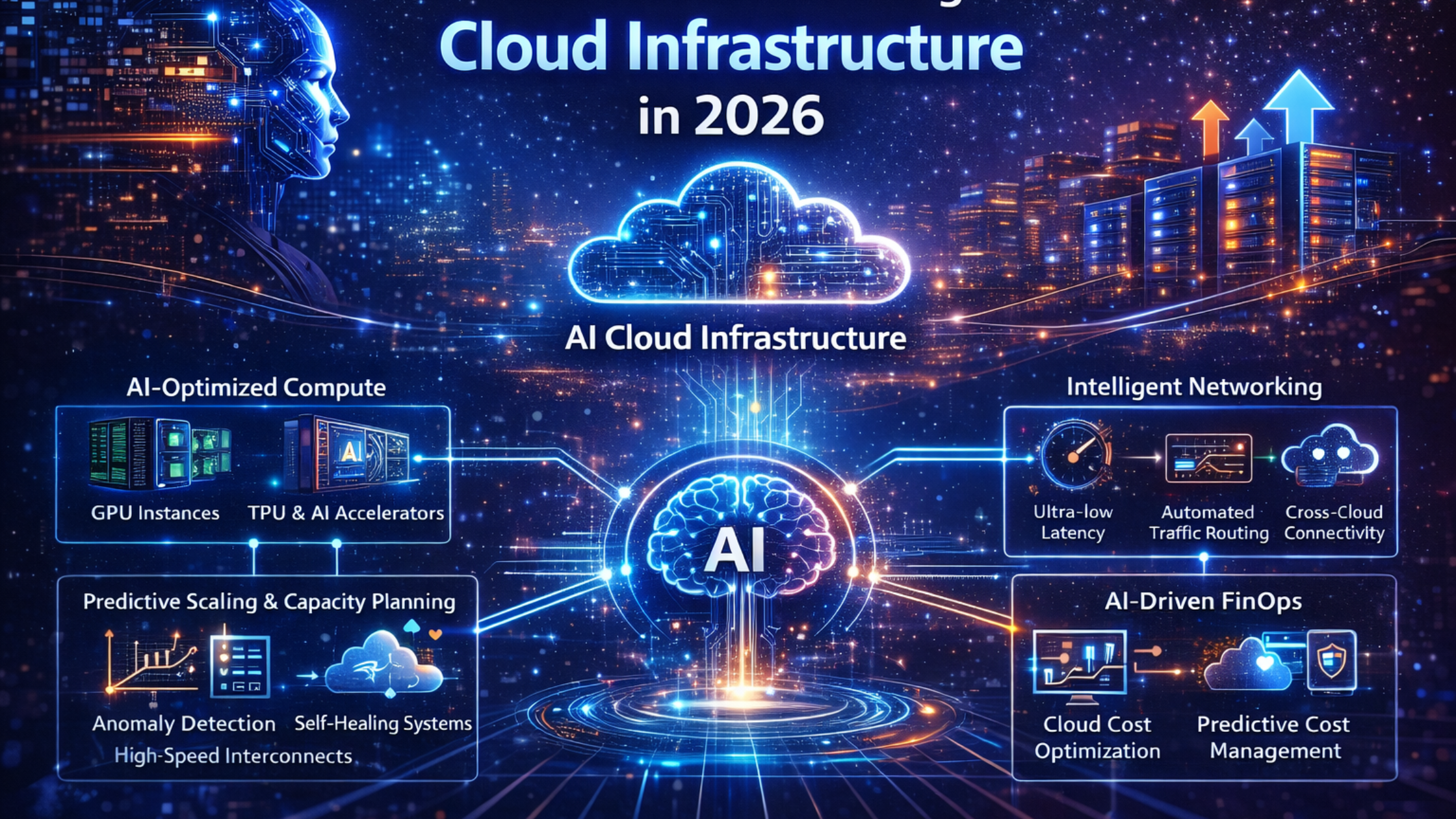
- GPU-dense and accelerator-rich instances
- TPUs and custom AI chips optimized for specific workloads
- High-bandwidth memory architectures
- Bare-metal AI nodes for latency-sensitive tasks
AI-driven schedulers analyze workload characteristics such as model size, memory requirements, and execution patterns to automatically select the most efficient compute configuration.
This intelligent compute orchestration improves:
- Training and inference performance
- Resource utilization
- Cost efficiency for AI workloads
Cloud Infrastructure Services now focus heavily on managing and optimizing these accelerator-heavy environments.
Predictive Scaling and Intelligent Capacity Management
Traditional autoscaling reacts to demand after it occurs, which often leads to performance degradation or over-provisioning. In AI-driven cloud infrastructure, scaling has become predictive rather than reactive.
How AI Enables Predictive Scaling
AI models analyze:
- Historical usage patterns
- Application telemetry and performance signals
- Seasonal and business-driven demand trends
- External events such as launches or campaigns
Based on this analysis, infrastructure scales proactively—sometimes minutes or hours before demand spikes occur.
This approach:
- Eliminates cold-start latency
- Improves application responsiveness
- Reduces unnecessary cloud spend
- Enhances overall system reliability
Predictive capacity planning has become a core feature of modern Cloud Infrastructure Services in 2026.
AIOps: The Rise of Autonomous Cloud Operations
As cloud environments grow more complex, manual operations become increasingly inefficient and error-prone. This has led to the widespread adoption of AIOps (Artificial Intelligence for IT Operations).
How AIOps Redefines Infrastructure Management
AI-driven operations platforms can:
- Correlate logs, metrics, traces, and events at scale
- Detect anomalies before they escalate into outages
- Perform automated root cause analysis
- Trigger self-healing workflows
In many environments, AI systems can now resolve incidents without human intervention by restarting services, reallocating resources, or rerouting traffic.
This shift significantly reduces:
- Mean time to detect (MTTD)
- Mean time to resolve (MTTR)
- Operational overhead
- Human dependency for routine incidents
By 2026, cloud infrastructure is increasingly autonomous, with humans acting as supervisors rather than operators.
AI-Driven Cloud Networking and Connectivity
Networking has emerged as a critical bottleneck for distributed AI systems. High-performance AI workloads depend on fast, reliable data movement across compute, storage, and regions.
AI’s Role in Modern Cloud Networking
AI-powered networking systems now:
- Optimize traffic routing in real time
- Predict congestion before it occurs
- Automatically reroute traffic to maintain low latency
- Balance workloads across regions and clouds
For multi-cloud and hybrid environments, AI enables intelligent connectivity that ensures consistent performance regardless of where workloads are deployed.
This results in:
- Improved application responsiveness
- Reduced network-related outages
- More efficient use of bandwidth
- Better support for global AI applications
Cloud Infrastructure Services now treat networking as an intelligent, adaptive layer rather than a static configuration.
AI-Enhanced Storage and Data Infrastructure
AI workloads are extremely data-intensive. Training and inference pipelines depend on fast, reliable access to massive datasets and model artifacts.
How AI Optimizes Cloud Storage
In 2026, AI-driven storage systems:
- Automatically tier data based on access patterns
- Predict future data access needs
- Optimize data placement close to compute resources
- Reduce I/O bottlenecks during peak workloads
These systems continuously learn from workload behavior, ensuring that frequently accessed data remains in high-performance tiers while inactive data is moved to cost-efficient storage.
This approach improves:
- Training and inference speed
- Storage cost efficiency
- Data availability across regions
Data infrastructure has become an intelligent component of cloud architecture rather than a passive repository.
AI-Powered Security and Zero-Trust Cloud Infrastructure
Security threats have become more sophisticated, making rule-based security controls insufficient. AI is now deeply embedded into cloud infrastructure security models.
Security Transformation Through AI
AI-driven security systems:
- Analyze behavior rather than relying solely on signatures
- Detect anomalies and insider threats in real time
- Continuously assess risk across infrastructure components
- Adapt security policies dynamically
Zero-trust architectures are increasingly enforced using AI, ensuring that every request is verified based on context, behavior, and risk profile.
In 2026, security is:
- Continuous rather than periodic
- Predictive rather than reactive
- Embedded directly into infrastructure layers
Cloud Infrastructure Services increasingly integrate security as a built-in capability rather than an add-on.
AI-Driven FinOps and Cost Intelligence
Cloud costs have grown more complex with the rise of GPU-heavy workloads and dynamic scaling models. Manual cost management is no longer viable.
How AI Transforms Cloud Cost Optimization
AI-powered FinOps platforms:
- Detect cost anomalies in real time
- Forecast cloud spending with high accuracy
- Recommend optimal instance types and scaling strategies
- Automatically shut down unused or inefficient resources
By correlating cost data with performance metrics, AI ensures that infrastructure delivers maximum value for every dollar spent.
This transforms FinOps from a reactive reporting function into a predictive, optimization-driven discipline.
AI as the Control Layer for Multi-Cloud and Hybrid Infrastructure
Multi-cloud adoption continues to grow as organizations seek flexibility, resilience, and vendor independence. However, managing multiple cloud environments introduces significant complexity.
AI’s Role in Multi-Cloud Strategy
AI acts as a unified intelligence layer by:
- Analyzing workload performance across clouds
- Optimizing placement based on latency, cost, and compliance
- Enforcing consistent governance policies
- Detecting cross-cloud dependencies and failures
This enables organizations to operate multi-cloud environments with greater efficiency and reduced operational overhead.
In 2026, AI is the key enabler of scalable, manageable multi-cloud architectures.
Evolving Role of Cloud Infrastructure Services
Cloud Infrastructure Services have evolved far beyond basic provisioning and monitoring.
Modern Cloud Infrastructure Services Focus On
- Designing AI-ready cloud architectures
- Managing GPU and accelerator-based environments
- Implementing AIOps and predictive monitoring
- Embedding security, compliance, and cost intelligence
- Supporting multi-cloud and hybrid strategies
For many organizations, partnering with experienced Cloud Infrastructure Service providers is essential to successfully navigate AI-driven complexity.
Business Impact of AI-Driven Cloud Infrastructure
AI-driven cloud infrastructure delivers tangible business benefits, including:
- Faster time-to-market for AI-powered products
- Improved application performance and reliability
- Lower operational and infrastructure costs
- Stronger security and compliance posture
- Improved scalability and future readiness
These benefits make AI-native cloud infrastructure a strategic advantage rather than just a technical upgrade.
Conclusion
In 2026, AI is no longer just running on cloud infrastructure—it is redefining it. Cloud platforms have become intelligent, predictive, and increasingly autonomous. From AI-optimized compute and predictive scaling to self-healing operations, intelligent security, and AI-driven cost optimization, cloud infrastructure is evolving into a living system that continuously adapts to business needs.
Organizations that embrace AI-driven Cloud Infrastructure Services will be better positioned to innovate faster, operate more efficiently, and scale securely in an AI-first digital economy.

Author