article
What Is a Version Control Tool? Essential Guide for USA DevOps Teams
By Sahil Dubey · Published
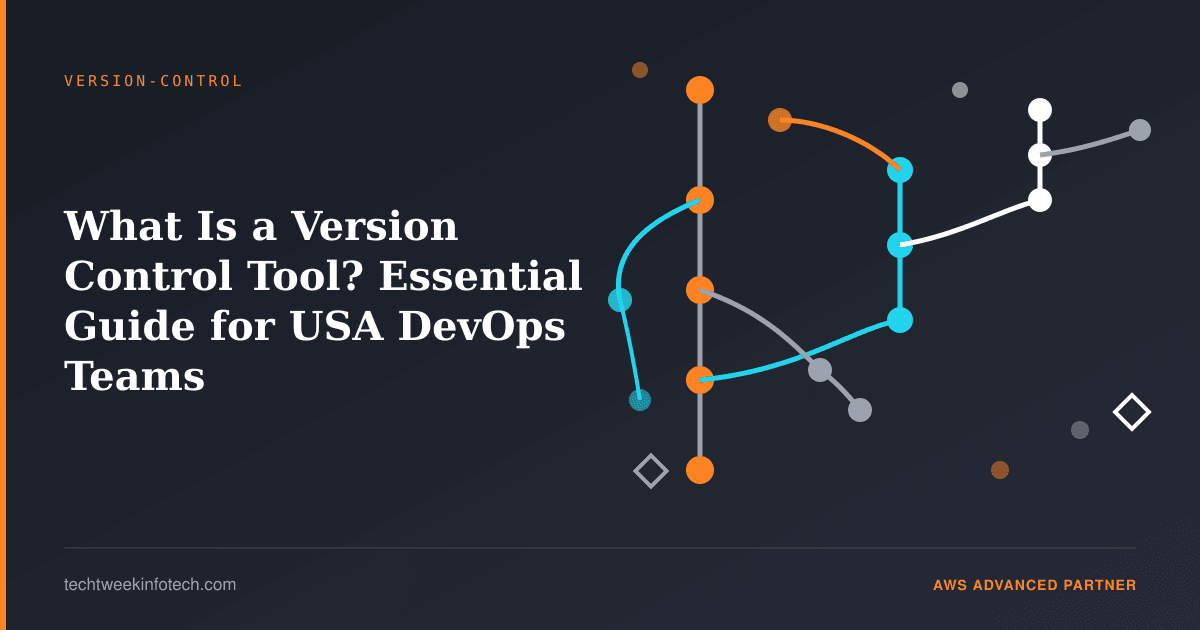
What Is a Version Control Tool? The DevOps Foundation for CI/CD and Infrastructure as Code
A version control tool (VCS) is software that tracks and manages changes to code, configurations, and infrastructure files over time, enabling teams to collaborate safely, audit changes, and automate deployments. In DevOps workflows, version control tools like Git, GitHub, and GitLab are non-negotiable—they're the backbone of continuous integration/continuous deployment (CI/CD) pipelines, infrastructure as code (IaC), and compliance frameworks such as HIPAA, SOC 2, and NIST CSF required by US enterprises. At Techtweek Infotech, an AWS Advanced Consulting Partner serving USA-based financial services, healthcare, and government clients across us-east-1 and us-west-2 regions, we've helped dozens of organizations leverage version control to accelerate delivery while meeting strict regulatory auditing requirements.
Why Version Control Tools Are Critical to DevOps Success
Version control is the invisible engine powering modern DevOps. Without it, infrastructure changes, application code, and configuration drift become chaotic—leading to downtime, security gaps, and failed compliance audits. Here's why every USA-regulated organization needs robust version control:
- Auditability & Compliance: SOC 2 (AICPA), HIPAA (HHS OCR), and FedRAMP require immutable logs of all system changes. Version control provides timestamped, cryptographically signed commit histories proving who changed what, when, and why—essential for FedRAMP compliance in AWS GovCloud and healthcare deployments.
- CI/CD Pipeline Automation: Version control triggers automated build, test, and deployment pipelines. Every code commit to GitHub or GitLab automatically runs security scans, compliance checks (NIST CSF controls), and smoke tests before reaching production—reducing manual errors and accelerating time-to-market.
- Infrastructure as Code (IaC) Management: Terraform, CloudFormation, and Ansible scripts stored in version control ensure infrastructure is reproducible, testable, and auditable. Changes to AWS security groups, RDS instances, or Kubernetes clusters in us-east-1 are versioned and tracked like application code.
- Rollback & Disaster Recovery: Version control enables instant rollback to any previous state. If a deployment breaks CCPA/CPRA data-handling rules or introduces a security vulnerability, teams can revert in seconds—critical in heavily regulated US markets.
- Team Collaboration at Scale: Branching strategies (Git Flow, trunk-based development) enable parallel work across distributed teams without conflicts, while pull request reviews enforce code quality and knowledge sharing—especially important for 24/7 follow-the-sun support models serving USA time zones from India.
Core Version Control Tools for USA DevOps: Git, GitHub, and GitLab
Git: The Distributed Foundation
Git is the open-source, distributed version control system underlying GitHub, GitLab, and Bitbucket. Every developer's machine holds a complete copy of the repository, enabling offline work and resilient, decentralized workflows. Git is the industry standard—used by 94% of professional developers per Stack Overflow surveys—and is essential for HIPAA and SOC 2 compliance because it supports cryptographic signing of commits and immutable audit logs.
USA DevOps scenario: A fintech firm in New York building a payment processing system on AWS us-east-1 uses Git to version Terraform infrastructure code and Node.js microservices. Developers on the East Coast and AWS SRE engineers in India (Techtweek NOC team) both work on the same Git repository, with every commit signed and logged for FedRAMP audit trails. On merge to main, automated tests run compliance checks against NIST CSF control requirements.
GitHub: Enterprise-Grade Git Hosting with Native CI/CD
GitHub, owned by Microsoft and running on AWS infrastructure (us-east-1 datacenters), is the dominant code hosting platform for USA enterprises. GitHub Actions—native CI/CD workflows triggered by Git events—enable pipeline automation without third-party tools. GitHub's branch protection rules, SAML/OAuth integration, and SOC 2 Type II certification align with HIPAA/FedRAMP security requirements.
Typical enterprise pricing: GitHub Enterprise typically costs $21 USD per user/month (with annual billing discounts) plus add-ons for advanced security scanning and SAML SSO. For a 50-person engineering team with DevOps automation, expect $12,600–$18,000 USD annually.
USA DevOps scenario: A healthcare software vendor in Boston uses GitHub with branch protection rules (require code reviews, run HIPAA-compliant security scans). GitHub Actions trigger Snyk container scanning, detect secrets, and validate CloudFormation templates before deployment to AWS. All commits are logged for HHS OCR audits, and GitHub's datacenters in us-east-1 ensure data residency compliance.
GitLab: Self-Hosted DevSecOps for Maximum Control
GitLab offers both SaaS (hosted on AWS us-west-2) and self-hosted Community/Premium editions. GitLab consolidates version control, CI/CD, container registry, and security scanning in one platform—valuable for organizations requiring on-premises infrastructure (AWS GovCloud, FedRAMP) or strict network isolation. Self-hosted GitLab running on your AWS account gives USA government contractors complete control over data location and audit logs.
USA DevOps scenario: A defense contractor building cloud infrastructure for US Department of Defense deploys GitLab Premium self-hosted on AWS GovCloud (us-gov-west-1). All code, CI/CD logs, and artifact repositories stay within FedRAMP Moderate boundaries. GitLab's SIEM integration logs every pipeline execution for NIST CSF audit compliance, and the platform's built-in secrets scanning prevents accidental exposure of AWS keys or database credentials.
How Version Control Enables CI/CD Pipelines and IaC in Regulated USA Environments
Version control is the trigger and truth source for everything DevOps. Here's how Techtweek implements this for USA clients:
- CI/CD Pipeline Trigger: Developer commits code to a Git branch → GitHub/GitLab webhook fires → automated build, test, and deploy steps execute. For a HIPAA-compliant healthcare application, every commit triggers SAST scanning (SonarQube), dependency auditing (Snyk), container image signing, and automated deployment to us-east-1 with encryption at rest (per HIPAA Technical Safeguards).
- Infrastructure as Code Versioning: Terraform modules, AWS CloudFormation templates, and Kubernetes manifests are stored in Git. A DevOps engineer submits a pull request to add a new RDS instance with HIPAA-compliant encryption; peer review, automated security scanning, and compliance validation happen before merge. Once approved, Terraform Plan is auto-generated, reviewed, and applied—all tracked in version control for FedRAMP audit trails.
- Multi-Environment Promotion: Git branches (feature → develop → staging → main) mirror environment progression (Dev → QA → Stage → Prod). Version control ensures that code tested in us-west-2 (Oregon) is byte-for-byte identical when promoted to us-east-1 (Virginia), critical for SOC 2 and NIST CSF consistency requirements.
- Secrets & Configuration Management: Version control is NOT used to store passwords or API keys (anti-pattern). Instead, Git stores reference architecture; secrets are injected via AWS Secrets Manager or HashiCorp Vault (also version-controlled for audit). A CCPA-compliant data pipeline stores data encryption keys in AWS KMS, referenced in infrastructure code, with all changes logged and immutable.
Real-World USA DevOps Consulting Scenarios Techtweek Delivers
- Fintech Compliance (SOC 2 + PCI DSS): A New York-based payment processor needs immutable audit logs for SOC 2 Type II certification. Techtweek sets up GitHub Enterprise with branch protection, automated security scanning, and CloudTrail integration (AWS logs all infrastructure changes). Every code commit, approval, and deployment is cryptographically logged—proof of SOC 2 control A.1.2 (change management).
- Healthcare IaC Automation (HIPAA): A Boston hospital system standardizes on Terraform + GitLab for infrastructure versioning. Patient-facing APIs deployed to HIPAA-compliant AWS workloads in us-east-1 with encryption and audit logging. Techtweek's 24/7 NOC monitors GitLab CI/CD pipelines from India; any deployment failure triggers immediate alerts per HHS OCR incident response requirements.
- Government Cloud Migration (FedRAMP): A US federal agency modernizing on AWS GovCloud uses GitLab self-hosted (air-gapped) for NIST CSF compliance. All infrastructure code commits are signed, approval chains are enforced, and deployment logs are cryptographically sealed for multi-year audit retention.
- Data Privacy (CCPA/CPRA): A California SaaS vendor implements version-controlled data pipelines with Apache Airflow + GitHub. Every ETL workflow change is audited; CCPA-mandated data deletion workflows are tested in staging before production deployment, all tracked in Git for regulatory proof of compliance.
Key Takeaways: Version Control as Your DevOps Foundation
Version control tools like Git, GitHub, and GitLab are not optional in modern DevOps—they're the foundation that enables CI/CD automation, infrastructure as code, team collaboration, and regulatory compliance. For USA enterprises subject to HIPAA, SOC 2, FedRAMP, NIST CSF, or CCPA/CPRA, version control provides the immutable audit trails and change management controls required by regulators and auditors. Whether you're deploying to us-east-1 (Virginia), us-west-2 (Oregon), or AWS GovCloud, implementing version control best practices—branch protection, signed commits, automated security scanning, and pull request reviews—is the fastest path to secure, auditable, scalable infrastructure.
FAQ: Version Control Tools and DevOps
What's the difference between Git and GitHub?
Git is the open-source version control system; GitHub is a SaaS platform that hosts Git repositories and adds features like pull requests, Actions (CI/CD), and team management. You can use Git without GitHub (via GitLab, Gitea, or self-hosted servers), but GitHub makes collaboration and automation easier for USA teams.
Is version control required for HIPAA or SOC 2 compliance?
Not explicitly mandatory, but highly recommended. HIPAA requires audit logs of system changes (HHS OCR Technical Safeguards); SOC 2 control A.1.2 requires change management documentation. Version control with signed commits and immutable logs is the easiest way to prove compliance. NIST CSF CM-3 (Change Control) explicitly calls for documented, authorized changes—version control delivers this.
Can I use version control for infrastructure code and secrets?
Yes for infrastructure code (Terraform, CloudFormation, Kubernetes YAML). No for secrets (passwords, API keys, database credentials). Use AWS Secrets Manager, HashiCorp Vault, or GitHub Secrets to store sensitive data; version control stores references to secrets, not the secrets themselves.
Which version control tool is best for USA government contractors?
GitLab self-hosted on AWS GovCloud is ideal because it gives you complete control over data location (FedRAMP Moderate/High compliance) and audit logs. GitHub Enterprise also works if your team prefers SaaS and uses GitHub's us-east-1 datacenters. Techtweek advises both—choose based on your GxP/FedRAMP requirements.
How does version control fit into a CI/CD pipeline?
Version control is the trigger and source of truth. A developer commits code → Git webhook fires → CI/CD platform (GitHub Actions, GitLab CI, Jenkins) automatically runs tests, security scans, and deployments. All activities are logged in version control, creating an immutable audit trail required by SOC 2, HIPAA, and FedRAMP.
Partner with Techtweek for Compliant DevOps Implementation
Version control is just the foundation. Techtweek Infotech, an AWS Advanced Consulting Partner, helps USA enterprises build end-to-end DevOps solutions that integrate version control, CI/CD automation, IaC, and compliance monitoring. Whether you're deploying payment processors in New York, healthcare systems in Boston, or federal workloads in AWS GovCloud, our 24/7 follow-the-sun NOC and India-based engineering team ensure your infrastructure is secure, auditable, and compliant with HIPAA, SOC 2, FedRAMP, NIST CSF, and CCPA/CPRA. Explore how we enable faster, safer deployments—visit our DevOps Services page to learn more.
How this article was made: drafted with AI assistance from Techtweek Infotech's own runbooks and engagement notes, then fact-checked and edited by our engineers before publishing. Corrections: hello@techtweekinfotech.com.